Quick Answer: Earth is the third planet from the Sun, about 4.54 billion years old, and the only planet in the universe with life. Water covers about 71% of the surface. The air is 78% nitrogen and 21% oxygen. The inner core has a temperature of 5,400°C.
Most lists of facts about the planet we live on stop at the seaside. Under your trainers, there is 6,371 km of rock and hot metal, and overhead is a skin of gas that keeps everything alive.
- The fifth biggest planet and the biggest of the rocky ones.
- Oceans cover 70.8% of the surface and 97% of the water.
- The shape is not a perfect sphere. There’s a bulge at the equator.
- Our magnetic field deflects solar wind and protects the atmosphere.
- Earth is the only planet with active plate tectonics.
10 Fascinating Facts About the Planet We Live On
- Earth is not round: Not flat. Spinning shoves the middle out, so it’s 43 km wider across the equator than pole to pole.
- A day is not 24 hours: A spin takes 23 hours, 56 minutes and 4 seconds. The missing four minutes come from our movement around the Sun.
- Coral reefs are bigger than whales: Coral reefs are the biggest living structures anywhere, built by pinhead-sized polyps laying down calcium carbonate for thousands of years.
- The Moon is drifting away: It moves roughly 3.8 cm a year, pulled out by the tides it drags about in our seas.
- We’ve barely glanced at the seabed: As of 2023, only 24.9% had been mapped properly.
- Earth is the densest planet in the Solar System: At 5.51 g per cubic centimetre, Earth is the densest planet going. Iron is 32.1% of the lot.
- Australia is wider than the Moon: The Moon is 3,474 km. Australia is nearly 4,000 km, coast to coast.
- The longest mountain range is soaking wet: The mid-ocean ridge runs 65,000 km along the seafloor, unseen.
- Lightning strikes about 6,000 times a minute across the planet.
- We’re the only planet named after dirt: “Earth” came from Old English and Germanic words meaning “the ground”, about 1,000 years back.
Also Read: Do Trees Talk to Each Other Underground? What the Science Says in 2026
Facts About the Planet’s Size, Orbit, and Seasons
We’re 12,756 km (7,926 miles) across at the equator, with a 40,075 km belt round the middle. The Sun sits 150 million km off, one astronomical unit. Its light takes just over eight minutes to reach you, so you always see a slightly old sun.
One lap: 365.25 days. That leftover quarter is why February borrows a day every four years. And we’re not strolling: 107,000 km per hour.
The tilt is 23.44 degrees. NASA explains that this tilt, not our distance from the Sun, gives us summer and winter. North leans in, north warms, and south shivers. Six months later, swap.
The Ocean: Earth’s Defining Feature
“Planet Ocean” would’ve been better. Saltwater covers 361 million square kilometres, averages 3,682 metres deep and holds 97% of our water. Only 2.5% is fresh, and 68.7% of that slumps as ice.
At Challenger Deep in the Mariana Trench the floor vanishes at almost 11,000 metres. Work shared by the Goldman Environmental Prize reckons two-thirds of ocean species are unnamed. Nearly every volcano is underwater too, and Hawaii’s Mauna Kea beats Everest base to summit.
Inside the Planet: Crust, Mantle, and Core
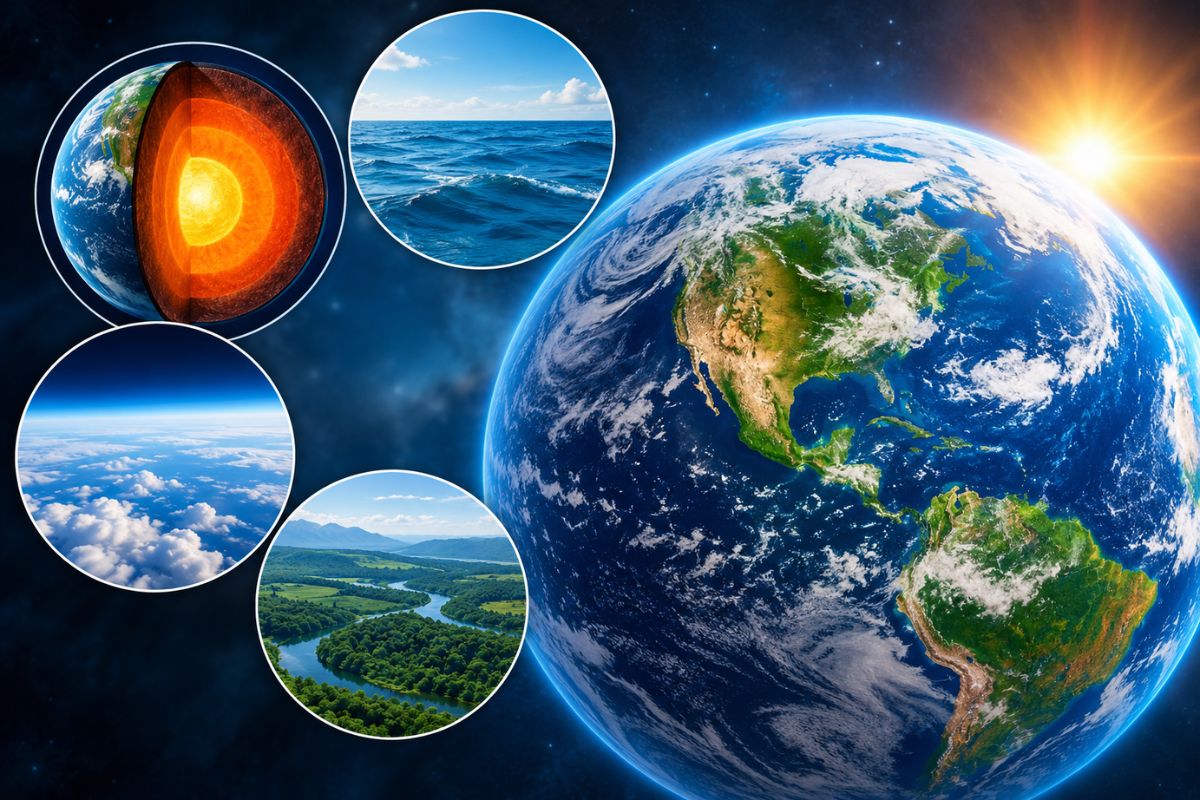
Earth has four layers, each less friendly than the last. The crust is a skin: 30 km under land, a pathetic 5 to 8 km under the sea. Then the mantle, 2,900 km of rock that oozes like caramel.
Below that, 2,300 km of liquid iron and nickel. Dead centre, a solid metal ball with a radius of 1,221 km and a temperature of around 5,400°C. It has the same heat as the Sun’s surface, but it stays solid only because the pressure is monstrous. Britannica traces the layering to our messy birth, when heavy stuff sank and light stuff floated.
Also Read: Can Dogs Eat Marmite? Everything Dog Owners Need to Know
A Moving Surface
That crust is cracked into a dozen or so plates, creeping at the speed your fingernails grow. Smash them together, mountains. Grind them past each other, earthquakes. India rammed Eurasia 50 million years ago and the Himalayas still climb over a centimetre a year. Wind back 250 million years and every continent sat in one blob: Pangaea.
Universe Today makes the point that matters: tectonics drags carbon down into the mantle. No recycling, no us. We’d have roasted like Venus.
The Air and the Magnetic Shield
The air is 78.08% nitrogen, 20.95% oxygen, 0.93% argon and a sprinkle of carbon dioxide. Thin as anything, yet it keeps us near 15°C. With the greenhouse effect, we’d sit at minus 18°C. Ozone deals with ultraviolet.
Deeper down, churning liquid iron works like a dynamo. Space.com has clocked magnetic north legging it towards Siberia at 50 to 60 km a year. The field flips now and then, last time 780,000 years ago. Particles that slip past smack into the air near the poles and glow. That’s the aurora.
Ice, Heat, and Extremes
Antarctica lugs the biggest ice sheet going: 30 million cubic kilometres. The European Space Agency notes that one slab holds 70% of the world’s freshwater and 90% of its ice.
Coldest: minus 89.2°C, Vostok. Hottest: 56.7°C, Death Valley, 1913. Driest outside Antarctica: the Atacama, under 1 mm of rain a year. Tallest: Everest, 8,849 m. Lowest land: the Dead Sea shore, 430 m down.
Life on a Rare Planet
Life began in the water 3.8 billion years ago. Maybe 8.7 million species live here; we’ve described 1.2 million. Humans turned up in Africa 300,000 years ago and sailed past eight billion in 2022. Wikipedia lists nine planetary boundaries for our mess. Five are breached.
Forests cover 30% of the land and soak up 8 gigatonnes of carbon dioxide a year. One Tree Planted argues that putting them back is the fix. The Planetary Society puts it best: astronauts come home different because, from orbit, our atmosphere looks far too thin for its job.
Also Read: Why Do Spiders Run Towards You? It’s Not What TikTok Said?
Frequently Asked Questions
What are the four layers of the Earth?
Ans: Crust, mantle, liquid outer core, and solid inner core. The crust is thinnest under the sea; the mantle hogs most of the volume.
How old is the Earth?
Ans: About 4.54 billion years, worked out by dating ancient rocks, Moon samples and meteorites.
Why is Earth the only planet with life?
Ans: Parked in the Sun’s habitable zone, water stays liquid here. Chuck in oxygen, a magnetic shield and live geology, and life gets a foothold.
How much of the Earth is water?
Ans: Water covers 70.8% of the surface. Around 97% is salty, so precious little is drinkable.
How hot is the centre of the Earth?
Ans: Around 5,400°C, near enough to the Sun’s surface. The pressure is so brutal the iron stays solid.
Is the Earth really a perfect sphere?
Ans: No. It’s an oblate spheroid: thick at the equator, squashed at the poles, with 43 km between the diameters.
Sources & References
- Goldman Prize – Two-thirds of ocean species are unnamed.