Verdict: Mostly False
No. As far as the experts tracking them can tell, there is no wild raccoon population living and breeding in the UK. Raccoons do turn up now and then, and the recent cases that can be traced involve escaped animals rather than wild-born ones. The species is treated as an invasive non-native animal of special concern, and in England and Wales it is illegal to keep a raccoon acquired after it was listed in August 2016.
That is the headline. The rest of this article covers how solid that answer is, what the latest news adds, and where the popular claims fall apart.
- No breeding wild population: Raccoons are not believed to breed in the UK, and the few sightings (Cornwall, Nov 2025) involve escaped animals.
- Banned since 2016: Raccoons were listed as an invasive species on 3 August 2016, so in England and Wales only pre-listing pets can legally be kept.
- On the watchlist: A 2025 horizon scan of 145 species placed raccoons in the top 20 most likely to become invasive in Britain.
- Germany shows the risk: Four released raccoons in 1934 grew to nearly two million, though the scale of the ecological harm is still debated.
- Report, don’t catch: If you see one, keep your distance, take a photo and report it to the Non-Native Species Secretariat.
Raccoons in the UK: Key Facts At a Glance
| Question | Answer |
| Is there a breeding wild population? | Not believed to be, as of November 2025 |
| Is the raccoon legally listed? | Yes, listed on 3 August 2016 as a non-widely spread invasive animal in England and Wales |
| Is it on the UK watchlist? | Yes, in the top 20 of a 2025 horizon scan of 145 species |
| Earliest wild record cited by the NNSS | Brecon, 1977 |
| Most recent high-profile case | Gwennap, Cornwall, November 2025 |
What Does The Record of UK Raccoon Sightings Actually Show?
The numbers are small. The British Pest Control Association (BPCA), citing records, says just 34 raccoons were seen out of captivity between 1977 and 2006, and that more than 20 sightings in England and Scotland were logged with the Non-Native Species Secretariat (NNSS) between 2014 and 2024. Those are reported sightings, not a population count, so they tell you how often an animal gets noticed and not how many are out there.
A few cases show what these incidents look like in practice:
- March 2016, near Garve, Highlands. A camera trap set up by the Blackwater Wildlife Recording Group to look for Scottish wildcats filmed a raccoon instead. NatureScot described it as an escaped raccoon.
- October 2018, Alfreton, Derbyshire. An elderly couple found an animal wedged between a shed and a wall. The RSPCA expected a badger and found a raccoon, according to UPI.
- November 2018, South Lanarkshire. The Scottish SPCA rescued a raccoon and said it believed the animal was an escaped pet.
- November 2025, Gwennap, Cornwall. Neighbours spotted a raccoon wandering through gardens. According to UPI, it weighed 24.69 pounds, more than three times what a healthy adult should. The RSPCA later said it had escaped from exotic pet owners, received care at its West Hatch Wildlife Centre in Somerset and was returned to its owners, with the premises checked to prevent another escape (MRCVS).
The Cornwall case matters for a reason that is easy to miss. It was publicised in June 2026 as part of the RSPCA’s “Don’t Let Them Loose” campaign, run with the government during Invasive Species Week. The charity reported 6,118 incidents involving 25,164 exotic animals in 2025. The raccoon is a rare example in a much larger pattern of escaped and abandoned exotic pets.
Also Read: From Oceans To The Core: 10 Fascinating Facts About the Planet We Call Home
Why Are Raccoons On The UK Invasive Species Watchlist?
Britain has been warned about raccoons for more than a decade. Horizon-scanning exercises led by the UK Centre for Ecology & Hydrology (UKCEH) in 2013, 2019 and 2025 have each tried to predict which non-native species could become invasive over the following ten years. In the 2025 round, which assessed 145 species, raccoons made the top 20 again.
BPCA reports that experts from 42 organisations across the UK and Europe took part. Helen Roy, who led the exercise, told Discover Wildlife that the lack of breeding raccoons so far is a sign horizon scanning is working, because it shows contingency plans exist and people are forewarned.
The NNSS species profile adds a sobering note. Raccoon populations are established in several western European countries, which it says suggests there are no ecological barriers to establishment in Great Britain. It also says the lack of establishment here “may result simply from chance”. The Channel is often credited with keeping raccoons out, but the NNSS does not rely on it as the explanation, and neither should we. A British raccoon problem would most likely begin with people, through an escape or a release, not with an animal swimming across.
What Happened In Germany, and Why Does It Matter For The UK?

Germany is the cautionary tale everyone cites, so it is worth getting the details right. Reporting by BBC Future, summarised by Euro Weekly News in August 2026, gives the following picture:
- In April 1934, forestry staff released two male and two female raccoons on the shore of the Edersee in Hesse, to “enrich the fauna”.
- After the Second World War, more animals escaped from a fur farm in Brandenburg. Genetic tests on more than 400 raccoons later pointed to at least two further introductions, one in eastern Saxony and one in the Harz Mountains.
- The population is now estimated at close to two million, with roughly 30,000 in and around Kassel. Older figures were lower, for example more than 1.6 million on the ZOWIAC wildlife monitoring site. These are estimates built partly on hunting statistics, not head counts.
- Most German states allow year-round shooting, and the annual cull now exceeds 250,000 animals, roughly four times the 2005 level. Numbers have kept rising regardless.
One popular story does not survive scrutiny. The claim that Hermann Göring ordered the release is repeated by tour guides and in tabloids. The former head of the local forestry office, Eberhard Leicht, went through the archives and found no evidence that Göring signed off on it or even knew about it.
The lesson for Britain is not that a UK outbreak would reach two million animals. It is that a founder group of four animals, plus later escapes, was enough to seed a continental population, and that once raccoons are established, culling has not stopped their growth in Germany.
How Harmful Are Raccoons, Really?
This is where claims online tend to run ahead of the evidence, so it helps to separate what is well established from what is contested.
Health risks. The NNSS says raccoons are important vectors of rabies in their native range and carry the roundworm Baylisascaris procyonis, which is highly pathogenic in humans and may be fatal. They also spread canine distemper and toxoplasmosis. In October 2025, Czech researchers reported in Frontiers in Veterinary Science the first detection of this roundworm in free-living raccoons in the Czech Republic, after examining ten animals from the Doupov Highlands between 2023 and 2025. That is a reminder that the parasite follows raccoons into new countries (Frontiers).
Property and nuisance. In urban areas raccoons raid bins and fruit trees and may use roof spaces, according to the NNSS. German reports describe damage to insulation and wiring.
Wildlife impact. The NNSS says raccoons may threaten vulnerable bird species and displace native carnivores. Euro Weekly’s summary of the BBC Future reporting says some studies show raccoons taking waterbird and amphibian eggs, while other researchers argue the evidence for wide-scale harm to German biodiversity is thin. A decade-long study in Müritz National Park found no evidence that raccoons are a major threat to native biodiversity, as summarised by The Cool Down. The honest position is that the ecological damage is plausible and the EU treats it as serious, but the size of the effect is still argued over.
In Britain specifically. The NNSS profile states that no impacts have been reported in Great Britain. Today the concern is prevention, not damage already done.
Also Read: Do Trees Talk to Each Other Underground? What the Science Says in 2026
Is It legal To Keep A Raccoon In The UK?
In England and Wales, generally no. The raccoon was listed on 3 August 2016 among 30 animal species of concern under rules that the Invasive Alien Species (Enforcement and Permitting) Order 2019 puts into effect. GOV UK says you must not keep a listed animal in your house, garden or business, sell it or exchange it, release it, let it breed or escape, import it, transport it within the UK, or export it.
There are narrow exceptions:
- Pets owned before listing. If you kept the animal as a pet before 3 August 2016, you can keep it for the rest of its life without a permit or licence, as long as it is a pet and not a business animal, is held in a contained enclosure it cannot escape from, does not breed, and is not sold or exchanged. You must not walk it, even on a lead. GOV UK says you should microchip it, but you do not have to neuter it.
- Rehoming. A pre-listing pet can be given, but not sold, to a new owner, who needs evidence the animal was a pet before the listing date.
- Zoos and research. Facilities can keep listed animals only with a permit, for research or conservation, and they must not let them breed.
If someone acquires a raccoon after the listing date, even without realising it was an offence, GOV UK says they must contact Natural England in England, Natural Resources Wales in Wales, or the police wildlife crime officer for guidance. Penalties range from warnings and notices to fines, seizure of animals and, at most, three months in prison for a summary offence or two years for an indictable one.
Two other points are worth knowing. First, the related raccoon dog, a canid and not a raccoon, was listed on 2 February 2019. The coati, a relative of the raccoon, was listed on 3 August 2016, so it is not a licensed alternative. Second, the GOV UK guidance applies to England and Wales only. Scotland and Northern Ireland run their own arrangements, so check NatureScot or DAERA if you are there.
Raccoon Myths Versus Facts
| Myth | What the evidence says |
| Wild raccoons live in British woodland. | Not believed to be breeding anywhere in Britain, according to the BPCA in November 2025. Individual escapes do occur. |
| Any masked animal at night is a raccoon. | Misidentifications happen in both directions. In 2018, rescuers in Derbyshire expecting a badger found a real raccoon. A clear photograph of the face and tail can help confirm its identity. |
| A raccoon dog is just another name for a raccoon. | A raccoon dog is a different animal belonging to the dog family. In February 2025, Natural Resources Wales appealed for sightings of one near Llyn Tegid in Gwynedd. |
| Germany’s raccoons came from a Nazi order. | BBC Future’s reported archive research found no evidence supporting this claim. The 1934 release was an administrative decision made by local officials. |
| You can own a raccoon if you get a licence. | Private ownership of raccoons acquired after their 2016 listing is generally prohibited. Exceptions cover qualifying pre-listing pets and permitted uses, such as certain zoo or research activities. |
| The sea keeps them out. | The NNSS suggests that Britain’s lack of an established raccoon population may be due to chance rather than simply the sea acting as a barrier. |
| Raccoons are proven ecological disasters everywhere. | Their potential ecological harm is recognised, but studies in Germany differ on the extent of the damage they cause. |
How Do You Identify A Raccoon, and What Should You Do If You See One?
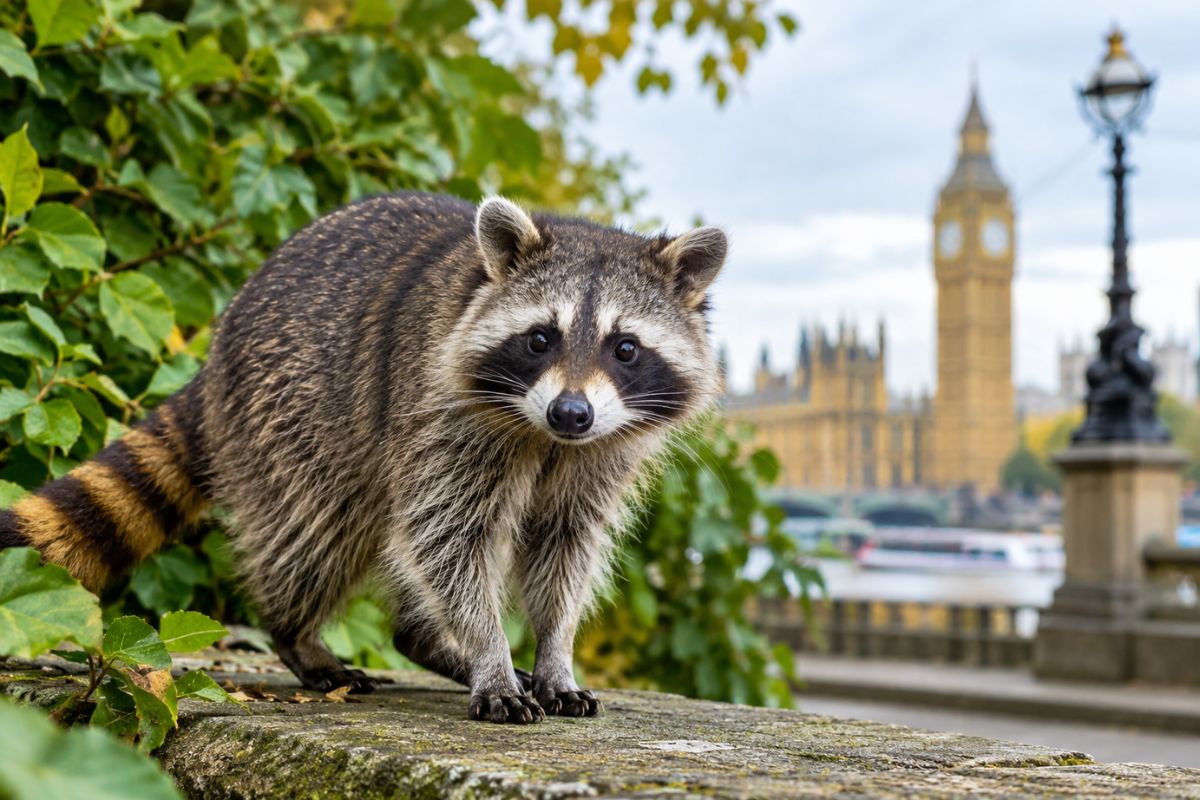
The NNSS describes the northern raccoon as a grey animal about the size of a large cat, with dark eye patches and a thick tail marked with black rings. The tail is the quickest way to tell it from a badger.
If you think you have seen one:
- Keep your distance. Do not try to catch it. GOV UK says listed animals should not be taken out of the wild by members of the public.
- Take a photo from a safe distance if you can, and note the exact place, date and time.
- Report it. GOV UK says a non-widely spread listed animal found in the wild or on your land must be reported to the Non-Native Species Secretariat. BPCA also points to the NBN Atlas map of recorded raccoon sightings.
- If the animal is injured or in distress, contact the RSPCA in England and Wales or the Scottish SPCA in Scotland.
- If you keep a pre-2016 pet, check the enclosure regularly. The RSPCA’s 2026 advice is to inspect for damage or wear and use secure containers for transport.
Will Raccoons Become Established In The UK?
Nobody can say for certain, and anyone who does is guessing. What the evidence supports is a narrower statement. The raccoon is a recognised risk, it has been on UK watchlists for more than a decade, and so far it has not bred in the wild here. The gap between a rare escape and an established population is breeding, and that is exactly what early reporting is meant to prevent.
Also Read: Do We Really Only Use 10% of Our Brain? Here’s What the Science Says
Frequently Asked Questions
Are there wild raccoons in the UK?
No breeding population is believed to exist. Occasional escaped animals are reported, such as the raccoon found in Gwennap, Cornwall, in November 2025.
Can you own a raccoon as a pet in the UK?
Not if it was acquired after 3 August 2016. In England and Wales you may keep a raccoon you owned as a pet before that date, for the rest of its life, under strict conditions. It must be kept in escape-proof housing, must not breed, and must not be sold or exchanged.
Are raccoons dangerous to people and pets?
They can carry diseases and parasites, including a roundworm that can be serious in humans, and canine distemper and toxoplasmosis. A raccoon cornered by a person is also a bite risk. In Britain, no impacts have been recorded from wild raccoons.
Is a raccoon dog the same as a raccoon?
No. A raccoon dog belongs to the dog family and is native to East Asia. It is a separate listed invasive species in England and Wales.
How many raccoons are there in Germany?
Estimates run from around 1.6 million in older figures to nearly two million in 2026 reporting. They are built partly on hunting statistics, so treat them as approximations.
Who do I report a raccoon sighting to?
The Non-Native Species Secretariat. If the animal is injured, contact the RSPCA or the Scottish SPCA.
Sources & References
- GOV.UK, Invasive non-native (alien) animal species: rules in England and Wales
- GB Non-Native Species Secretariat, Raccoon (Procyon lotor) species profile
- BPCA, Raccoons remain on watchlist following Cornwall sighting (25 November 2025)
- Discover Wildlife, Raccoons among invasive species that could threaten British wildlife in next 10 years
- Euro Weekly News, Four raccoons set free in 1934 now number nearly two million across Germany