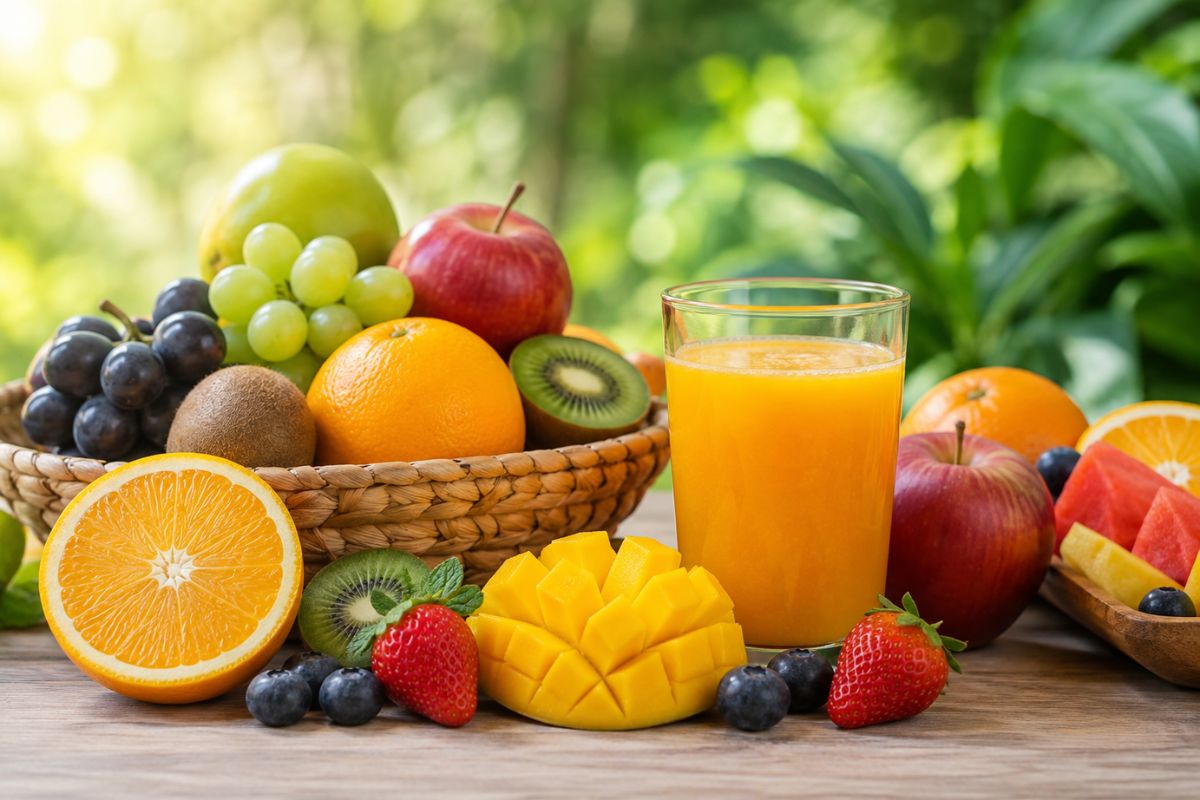
Short answer: not really. A glass of orange juice and an actual orange share a lot of the same vitamins, but your body doesn’t treat them the same way. Once you strip the fiber out of a fruit, you change how fast the sugar hits your bloodstream, how full you feel afterward, and — according to research published over the last year — your longer-term risk of things like high cholesterol and type 2 diabetes. Juice isn’t junk food. But it isn’t a stand-in for the fruit it came from either, and the newest science is making that gap harder to ignore.
- Whole fruit and fruit juice are not nutritionally equal. Even 100% juice, with no added sugar, behaves differently in your body than the fruit it came from.
- Fiber is the deciding factor. Juicing removes the fiber matrix that slows digestion, blunts blood sugar spikes, and keeps you feeling full. Without it, juice is absorbed almost like sugar water.
- Juice raises blood sugar faster than whole fruit. Because it’s liquid, it empties from the stomach quickly and delivers “free sugar” that’s absorbed almost immediately — the same sugar category found in soda.
- Real-world data backs this up. A 2026 study of 400+ people found juice drinkers had the highest rates of high cholesterol and diabetes (after the no-fruit group), plus higher BMI, lower energy, and worse sleep quality than whole-fruit eaters.
- Smoothies are the middle ground. Blending keeps the fiber intact — it’s just broken into smaller pieces — so smoothies sit much closer to whole fruit than to juice, nutritionally speaking.
Why This Question Won’t Go Away
Juice has always occupied a strange middle ground in the grocery store. It sits near the produce aisle, gets marketed as part of a “balanced breakfast,” and for years carried the same 5-a-day badge as an apple or a banana. That messaging stuck. Most people grew up believing a glass of OJ was basically fruit in liquid form.
It isn’t, and the last two years of research have made that distinction sharper than ever.
Also Read: Is Intermittent Fasting Safe? 5 Myths the 2026 Research Clears Up
The Study That Reframed the Debate
In May 2025, a team of researchers — Hemangi Mavadiya, Dahyun Roh, Andrew Ly, and Yunxia Lu — published a review in the journal Nutrition Bulletin that laid out, plainly, what happens when fruit gets juiced. Processing strips out fiber, reduces vitamin and antioxidant content, and converts the sugar that was locked inside the fruit’s cell walls into what nutrition scientists call “free sugar” — the same category as the sugar in soda.
That last part matters more than it sounds. Sugar trapped inside intact plant cells has to be digested before it’s absorbed. Free sugar doesn’t. It’s already loose, so your gut absorbs it almost immediately, and your blood sugar rises faster than it would from eating the same fruit whole.
There’s also a satiety piece most people never think about. Solid food, including fruit, takes longer to leave your stomach — a process called delayed gastric emptying — which is part of why an apple keeps you full longer than apple juice does. Juice, being liquid, moves through you quickly and doesn’t trigger the same fullness signals. The researchers also pointed to fiber’s role in feeding gut bacteria, which produce compounds that lower inflammation — another benefit that mostly disappears once the pulp is gone.
Their conclusion wasn’t subtle: current U.S. dietary guidelines don’t clearly define “free sugar” in fruit juice, and the 2025–2030 update, they argued, needs to fix that and say outright that whole fruit should come first.
Then a Real-World Study Backed It Up
Reviews are useful, but they’re built on other people’s data. A newer study, published in Frontiers in Nutrition and covered by Euronews in April 2026, actually went out and tested it.
Researchers surveyed more than 400 people and split them into four groups based on how they usually got their fruit: barely any fruit at all, mostly juice, mostly smoothies, or mostly whole fruit. Then they looked at outcomes.
People eating almost no fruit came out worst overall, with the highest rates of high blood pressure and heart disease — which makes sense, since no fruit at all is a tougher starting point than any fruit. But the juice drinkers weren’t far behind. They had the highest rates of high cholesterol and diabetes of any group, plus a higher average BMI than the whole-fruit and smoothie groups.
What surprised me most, reading through the findings, wasn’t the metabolic data — it was the day-to-day stuff. Juice drinkers reported the lowest energy levels and the worst sleep quality of anyone in the study. Researchers tied that back to the same fiber-and-satiety issue: juice just doesn’t sustain you the way solid food does, so people who lean on it may be running on emptier tanks than they realize. Juice drinkers and the low-fruit group also reported more mental health struggles over the previous year than the whole-fruit or smoothie groups did.
Smoothies, interestingly, landed much closer to whole fruit than to juice. Blending doesn’t remove fiber — it just chops it up — so a smoothie keeps most of that benefit intact, and the researchers noted it may even help your body absorb certain nutrients like vitamin C and folate a bit more easily.
Also Read: Does Microwaving Food Destroy All Nutrients? Harmful or Safe
Fiber Is Doing More Work Than People Realize
If there’s one thread running through all of this research, it’s fiber. Whole fruit gives you the juice and the structure around it — skin, pulp, cell walls — and that structure isn’t just filler. It slows digestion, keeps things moving through your gut, feeds your microbiome, and blunts how fast sugar reaches your blood. Take it away, and what’s left is, functionally, sweetened water with some vitamins floating in it.
That’s the reason fruit juice tends to have a higher glycemic index than the fruit it’s made from. Liquids get absorbed faster than solids — plain physiology — so a glass of orange juice can spike your blood sugar and insulin harder and faster than eating an orange would. It’s also part of why juice tends not to fill you up: research cited by Stanford Medicine Children’s Health found that people who drank a daily glass of 100% fruit juice gained close to half a pound over three years, on average, while people who added an extra daily serving of whole fruit lost about a pound over the same stretch. Small numbers, but they point in opposite directions.
A separate, often-cited review in Advances in Nutrition looked specifically at chronic disease risk tied to 100% fruit juice — not sugary fruit drinks, the real stuff. It found that some 100% juices actually carry as much sugar, ounce for ounce, as regular soda. Outside of a higher cavity risk in kids and some modest weight gain, the review didn’t find strong evidence that moderate juice drinking directly causes serious disease. But it didn’t call juice equivalent to whole fruit either — mostly, it argued that since most people don’t eat enough fruit anyway, juice is better than nothing.
What Health Authorities Around the World Are Saying
Guidance differs slightly by country, but it’s converging on the same basic idea.
The World Health Organization recommends at least 400 grams of fruits and vegetables a day for anyone over 10, with an emphasis on whole, minimally processed forms. The UK’s NHS goes further and specifically caps combined fruit and vegetable juice or smoothie intake at 150 milliliters a day — about one small glass — precisely because juice sugar hits the bloodstream faster than sugar in whole fruit. In the U.S., current Dietary Guidelines still let 100% juice count toward fruit intake, but that’s the exact policy under pressure following the 2025 review, ahead of the 2025–2030 revision. The American Academy of Pediatrics and USDA both recommend that at least half of daily fruit intake come from whole fruit, not juice, especially for young kids. And the Nordic Nutrition Recommendations, updated in 2023, specifically advise limiting juice for children.
None of these bodies are telling people to avoid juice entirely. But not one of them treats it as a full replacement for whole fruit anymore, and that’s a meaningful shift from how juice was framed a decade ago.
Is Juice Actually Bad, Then?
Not bad — just not equal. A glass of 100% fruit juice still gives you real vitamin C, potassium, folate, and plant compounds called polyphenols, and if you genuinely don’t eat much fruit, it beats skipping fruit altogether. Fortified versions can also be a decent source of calcium and vitamin D.
The honest way to put it: juice isn’t empty, it’s incomplete. You’re getting most of the sugar and calories of the original fruit, absorbed faster, without the fiber that would normally slow all that down and keep you full. Context changes things too — a small glass with breakfast behaves differently in your body than a large bottle sipped all day on an empty stomach.
What This Actually Means for Your Day-to-Day
- Eat the fruit first, when you can. Fiber, fullness, and a gentler blood sugar curve — juice can’t match any of it.
- If you drink juice, keep it small. Most current guidance lands around 150 mL a day, roughly half a cup, and less for young kids.
- Have it with food, not alone. Pairing juice with a meal softens the blood sugar spike compared to drinking it by itself.
- Smoothies are a reasonable middle ground — fiber stays in — as long as you’re not loading them with syrups, juice bases, or oversized portions.
- Check the label. “100% juice” and “juice drink” aren’t the same product. A lot of juice drinks are mostly water and added sugar with a small amount of actual juice.
The Bottom Line
Two separate pieces of research, released less than a year apart — a 2025 scientific review and a 2026 population study — landed on the same answer from different directions. Whole fruit and fruit juice are related, but they’re not the same thing metabolically. Whole fruit wins on fiber, fullness, and long-term markers like cholesterol and diabetes risk. Juice still has a place, especially for people who otherwise skip fruit entirely, but the evidence increasingly says: treat it as an occasional extra, not a substitute for the real thing.
Frequently Asked Questions
Does fruit juice count toward my 5-a-day?
Usually, yes, but only up to a small amount — around 150 mL under UK NHS guidance — and only as one portion total, no matter how much you drink, since it’s missing the fiber whole fruit has.
Is fresh-squeezed or cold-pressed juice better than store-bought?
It keeps more vitamins and skips the added sugar, but it’s still missing fiber and still spikes blood sugar in a similar way to bottled juice.
Are smoothies as good as whole fruit?
Close. Blending keeps fiber intact, which is the main thing juicing removes. Just watch for added sugar, juice bases, and oversized servings.
Is fruit juice as bad as soda?
No — it has real nutrients soda doesn’t. But some 100% juices match soda’s sugar content ounce for ounce, so portion size still matters.
How much juice is safe to drink daily?
Most current guidance points to around 150 mL a day for adults — about half a cup — with tighter limits recommended for young children.