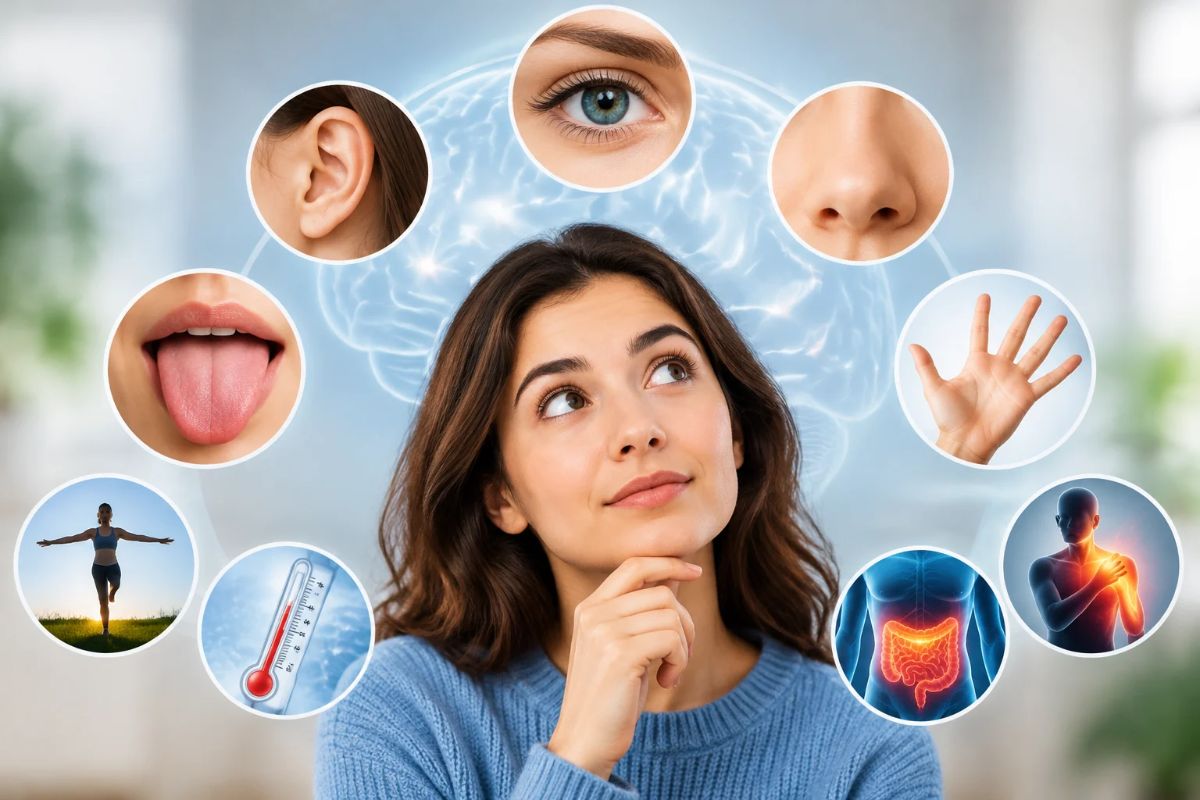
No. Humans have more than five senses. Sight, hearing, smell, taste and touch are only the five best known. Scientists also recognise senses such as balance, pain, temperature, body position (proprioception) and the awareness of your internal organs (interoception). There is no single agreed total. Neurologists commonly count at least nine, and broader classifications reach 21 or more, depending on how “sense” is defined.
- The five-sense model goes back to Aristotle, more than 2,300 years ago.
- Neurologists generally agree on at least nine senses.
- Widely accepted extra senses include thermoception (temperature), nociception (pain), equilibrioception (balance), proprioception (body position) and interoception (internal body signals).
- Some receptors do double duty. Certain cells in your eyes help tell your brain whether it is day or night.
- Flavour and wetness are built by the brain from other signals. You have no dedicated receptor for either.
- Whether humans have a true magnetic sense is still unsettled.
- “53 senses” is a number from one researcher’s very broad definition, not a scientific consensus.
Where the “Five Senses” Idea Came From
Aristotle is usually credited with first listing the senses in his work De Anima. His list was sight, hearing, smell, taste and touch. It was neat, easy to teach and easy to remember, so it stuck in school textbooks for centuries.
The problem is that it was never meant to be a complete map of the body. As one psychologist put it, the five-sense model is the kind of simplification we give small children, and it rarely gets corrected later unless you happen to study the subject.
Also Read: Are Humans Mammals? Yes, and the Evidence Is Not Close
So How Many Senses Do We Have?
It depends on who is counting and how they define a sense.
A commonly used neurological definition says a sense is a group of sensory cells that responds to a specific physical stimulus and connects to a specific region of the brain. Under that definition, neurologists agree on at least nine senses. Classifications that allow more overlap give up to 21. Things like hunger and thirst are often kept separate from that count.
At the far end sits the figure of 53, proposed by eco-psychologist Michael J. Cohen. He includes things like a sense of mood linked to colour and even a sense of self. That is a broader, more philosophical definition, and it is not how neuroscientists usually count.
| Counting Method | Number of Senses | Who Uses It |
| Traditional | 5 | School teaching, everyday speech |
| Neurological | 9 or more | Neurologists |
| Extended Classification | Up to 21 | Broader scientific classifications |
| Cohen’s Model | 53 | One researcher’s wider definition |
The “Hidden” Senses You Use Every Day
Temperature (thermoception). Feeling hot or cold is often lumped in with touch, but it runs on its own receptors and its own brain pathways. It also helps your body regulate its internal temperature.
Pain (nociception). Pain was once treated as touch turned up too high. That idea fell apart once dedicated pain receptors were found. They exist in the skin, the bones and the internal organs. People born unable to feel pain, which is rare, tend to injure themselves badly because they miss the warning signs.
Body position (proprioception). Close your eyes and touch your nose. You can do it because nerve cells in your muscles, joints and tendons constantly report where your limbs are. It is why you can walk without staring at your feet.
Balance (equilibrioception). Deep inside the ear, the vestibular system detects movement and rotation. Balance is really a team effort between the ear, your vision and proprioception.
Internal body signals (interoception). Thirst, a full bladder, a racing heart, a rumbling stomach: this is your brain reading what is happening inside you. Researchers once thought it existed mainly to keep the body stable. Newer work suggests it also feeds into emotion, motivation and self-awareness.
Day and night. Some cells in the retina do not help you see at all. They tell your brain whether it is light or dark outside, which feeds your sleep and wake cycle.
Senses the Brain Builds From Other Senses
Not everything you experience has its own receptor. Flavour is assembled by the brain from taste and smell. The feeling of wetness comes from combining touch and temperature.
Neuroscientist Dr Lisa Feldman Barrett goes further. She argues that your brain is always predicting what you are about to see, hear or feel, and then blends those predictions with incoming signals. In her words, you do not experience sensations with your sense organs. You experience them with your brain.
The senses also interact. Research she describes shows that your brain takes in slightly less visual information at the moment your heart contracts. Vision and your heartbeat are connected.
Also Read: Do Elephants Think Humans Are Cute? What the Science Actually Says
What About a Magnetic Sense?
This is where the evidence gets thinner. One 2019 study reported that some people’s brainwaves changed when the surrounding magnetic field was rotated, even though they did not notice it. Magnetite crystals have also been found in the human brain. Humans also have a light-sensitive protein in the eye that responds to magnetic fields.
But researchers have not confirmed that people actually use any of this to find their way. Treat it as an open question, not an established sense.
Verdict: False
The claim that humans have only five senses is false. It is a simplification from ancient times that modern science has outgrown. The honest answer is “more than five, and the exact number depends on how you define a sense.” Anyone who gives you one precise number, whether 9, 21 or 53, is quietly choosing a definition.
Frequently Asked Questions
How many senses do humans have?
At least nine according to most neurologists, and up to 21 under broader classifications. There is no single official number.
What are the five traditional senses?
Sight, hearing, smell, taste and touch. They were first listed by Aristotle.
What is the sixth sense in humans?
There is no official “sixth sense.” People often mean intuition, but science points to real overlooked senses like balance, proprioception, temperature and interoception.
Is balance a sense?
Yes. It combines signals from the inner ear, vision and body-position receptors.
What is interoception?
It is the sense of what is going on inside your body, such as hunger, thirst, heartbeat and breathing.
Is flavour the same as taste?
No. Taste comes from the tongue, while flavour is built by the brain from taste and smell together.
Do humans have a magnetic sense like birds?
Not proven. Some studies hint at it, but there is no confirmed everyday magnetic sense in humans.
Is “sense of direction” a real sense?
Neurologists usually classify it as a mental activity built on other senses, not a separate sense.
Why do some sources say 53 senses?
That figure comes from one researcher’s very wide definition, which includes mental and emotional experiences.