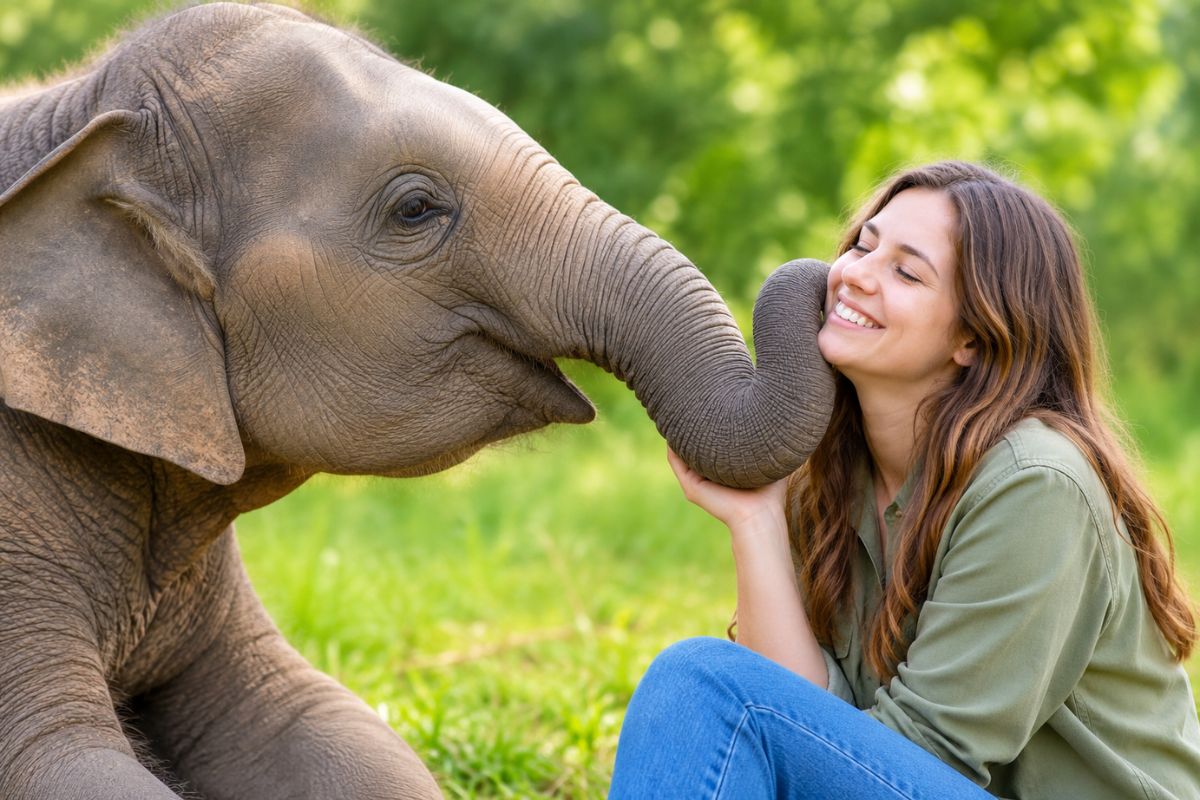
No. There is no scientific evidence that elephants find humans “cute” the way we find puppies. The claim came from a viral social media post, not a study. Research from 2024 to 2026 does show something more interesting: elephants notice us, read our attention, recognise familiar voices, and in the wild often treat us with caution.
- The claim says elephants see humans as “cute,” like kittens or puppies, and it spread through Tumblr and Twitter screenshots in December 2017.
- Snopes published its review on 27 December 2017 and listed the claim as not verifiable.
- A veterinary wildlife expert told Africa Check that wild elephants “definitely do not see us as cute” and are more likely to see us as a threat.
- Recent studies show elephants can read human attention and tell familiar voices from unfamiliar ones, but none of them measure “cuteness.”
Where Did The “Cute” Claim Come From?
The idea took off in late 2017. The post said the same part of an elephant’s brain lights up when it sees a human as when a human sees a puppy. Content-aggregating websites reposted it uncritically and presented it as scientific fact.
No study behind it has ever been produced. Africa Check explains why none could exist: an elephant would have to be awake and almost perfectly still for a brain scan to work, which is nearly impossible. Even with a scan, there would be no way to know whether the lit-up areas serve the same emotions as in humans, because the brains work differently.
Also Read: Are There Raccoons in the UK? Separating Facts From Myths
Why Humans Find “Cuteness” So Convincing
Cuteness is a human reaction. Baby-like features trigger a positive response in the emotion- and pleasure-related parts of our brains. The claim projects that reaction onto elephants. It is an example of anthropomorphism, the habit of reading human feelings into animals. Elephants make the habit easy, because they have rich social lives and visible emotional bonds with each other.
What Wild Elephants Appear To Think Of Us
Africa Check’s expert, Leith Meyer of the University of Pretoria, points to history. Past experiences have produced a kind of evolutionary hard-wiring, so elephants treat us the way they treat big predators such as lions.
Recent field data fits this picture. A Botswana study led by Marlee Tucker of Radboud University, published in Integrative Conservation in March 2026, tracked ten African mammal species with camera traps. Baboons, hyenas, impala, kudu, sable antelope and waterbuck overlapped more in time with humans in agricultural corridors, while elephants reduced their overlap. That behaviour points to avoidance, not affection.
Pressure on habitat adds to the tension. Human-elephant conflict is driven mainly by habitat loss, and Wikipedia’s summary reports hundreds of human deaths and hundreds of Asian elephant deaths each year in affected countries.
What About Tame And Captive Elephants?
This is where the myth gets its small grain of truth. Meyer says the “cute” idea likely comes from trained elephants that rely on people to survive and may change their behaviour to do so.
A 2017 study at Knysna Elephant Park in South Africa, led by Lynette Hart of UC Davis, looked at this directly. Tamed elephants preferentially and favourably interacted with humans they had a special relationship with, and they started those interactions themselves. Hart was careful about what that means: “We don’t know what elephants ‘think’ about humans.” The study shows bonds with particular people. It does not show that elephants think we are cute.
Also Read: From Oceans To The Core: 10 Fascinating Facts About the Planet We Call Home
What New Research Shows (2024–2026)
Elephants read human attention. A study by Hoi-Lam Jim, Shinya Yamamoto, Pakkanut Bansiddhi and Joshua Plotnik used ten adult female Asian elephants in Chiang Rai, Thailand. The authors describe it as the first study to show that Asian elephants are sensitive to human attentional states. Lead author Jim said the elephants did not gesture simply because a human was present. They responded to how the person was oriented.
Elephants tell voices apart. A June 2026 study in Behavioural Processes, led by Annaëlle Surreault-Châble, tested captive Asian elephants. The elephants distinguished familiar from unfamiliar voices, and elephant-directed speech from adult-directed speech. They turned toward the keepers’ doors more when they heard elephant-directed speech or a familiar voice.
Elephants have “names” for each other. This 2024 finding is the real reason elephants seem so human. The Nature Ecology & Evolution study found that wild African elephants address one another with individually specific calls. The researchers played recordings to 17 elephants. The elephants responded more strongly to calls addressed to them and did not react to calls meant for others. That shows elephants have rich social lives. It tells us nothing about how they feel about humans.
Myth vs. Evidence
| Claim | Verdict | Why |
| Elephants’ brains react to humans like ours react to puppies | Unsupported | No study exists, and the method is not feasible |
| Wild elephants find humans cute | Contradicted | Experts and field data point to wariness and avoidance |
| Tame elephants bond with some people | Supported | Documented at Knysna Elephant Park |
| Elephants recognise voices and attention | Supported | 2025–2026 studies on Asian elephants |
Also Read: Can Dogs Eat Marmite? Everything Dog Owners Need to Know
Frequently Asked Questions
Do elephants think humans are cute?
No evidence supports it. The claim comes from a viral 2017 post, and fact-checkers could not verify it.
Can elephants recognise individual people?
Captive Asian elephants can tell familiar voices from unfamiliar ones, according to the June 2026 study above. Recognising someone is not the same as finding them cute.
Do elephants bond with their keepers?
Tamed elephants appear to value relationships with particular humans. Researchers caution against reading human emotions into those bonds.
Are wild elephants dangerous to humans?
They can be. Elephants can be extremely unpredictable around people, and conflict over land and crops is a serious problem in parts of Africa and Asia. Keep a safe distance.
Why does the myth keep spreading?
It is a pleasant idea, and elephants really are intelligent and emotional animals.
The Bottom line
Elephants don’t find us cute, and no study ever said they did. What the evidence does show is that elephants pay attention to us, learn our voices and body language, and in the wild keep their distance. That is more interesting than the myth, and it suggests we should treat elephants as the cognitively sophisticated animals they are.
Sources & References
- Africa Check, “No, elephants don’t think people are ‘cute’ – in the wild they see us as a threat”
- Snopes, “Do Elephants Think Humans Are Cute?” (2017 fact-check, also covers Hart’s Knysna study)
- Pardo et al., “African elephants address one another with individually specific name-like calls,” Nature Ecology & Evolution
- Jim et al., “Asian elephants (Elephas maximus) recognise human visual attention from body and face orientation,” Scientific Reports
- Surreault-Châble et al., “Are you talking to me? Captive Asian elephants react to voice familiarity and Elephant-Directed speech,” Behavioural Processes