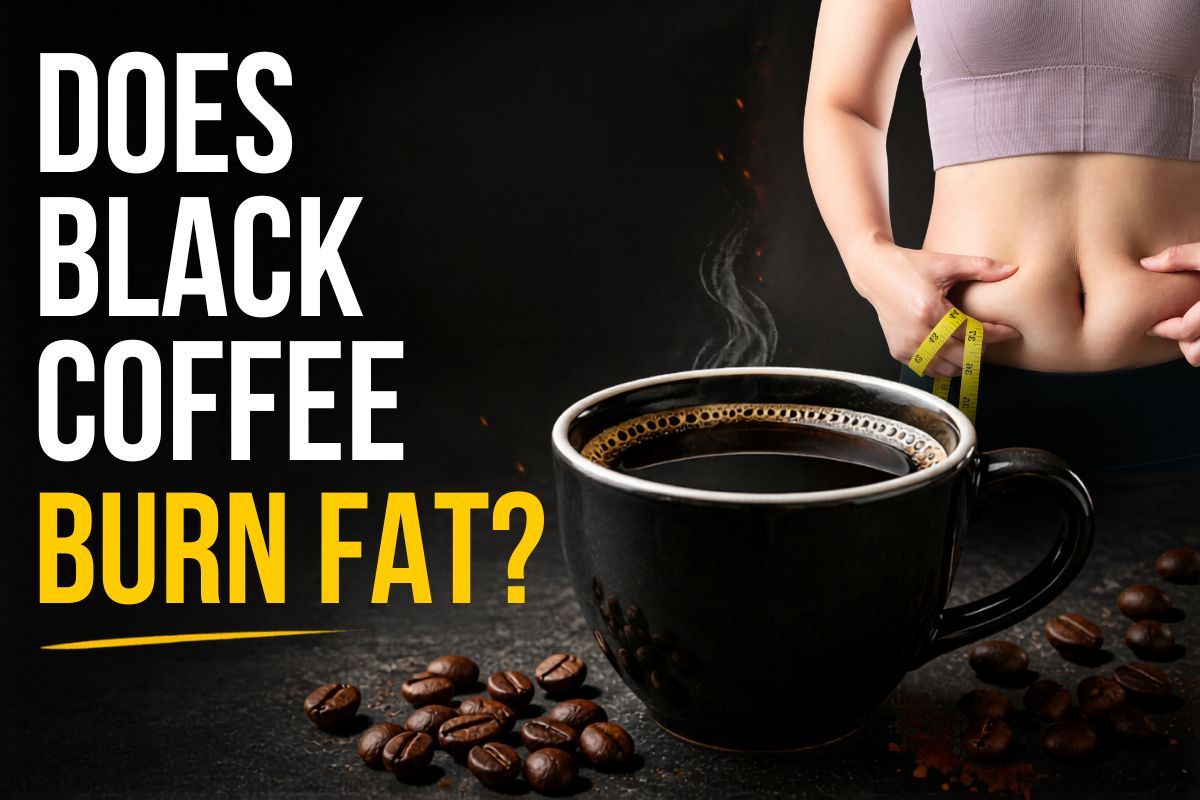
Does black coffee burn fat? Yes – but not in the way your gym buddy is telling you. Caffeine, the active compound in black coffee, can raise your metabolic rate by 3–11% and increase fat oxidation during exercise by up to 29% in lean individuals. These effects are real, science-backed, and short-lived. Black coffee is a genuinely useful tool inside a calorie deficit – it is not a fat burner in a cup.
Key Points
- Black coffee contains caffeine, which triggers a real but temporary metabolic boost
- Caffeine does increase fat oxidation during aerobic exercise – the research is solid on this
- The effect is weaker in regular coffee drinkers and people with obesity
- Adding milk, sugar, or syrups cancels most of the benefit immediately
- Black coffee does not “target” belly fat – that claim is not supported by science
- Too much coffee raises cortisol, which can actively work against fat loss
Picture this. It is a grey Tuesday morning somewhere in Manchester. You are standing in the office kitchen, watching a colleague pour themselves a black Americano – no milk, no sugar – with the quiet confidence of someone who has watched one too many fitness reels on Instagram. “I’ve switched to black coffee,” they announce to no one in particular. “It burns fat.”
Half the office nods, and the other half reaches for the oat milk. And somewhere in between, the actual truth about black coffee and fat burning is getting completely buried under a mountain of wellness content and pre-workout marketing.
Here is the fact-check: Does black coffee burn fat? The answer is more interesting – and more honest – than most of what you will find online.
Also read: Can Lemon Water Cure Fatty Liver? Here’s the Truth No One Tells You
How Does Black Coffee Burn Fat? The Real Mechanism
So, how does black coffee burn fat exactly? When caffeine hits your bloodstream, it travels to your brain and blocks a chemical called adenosine – the one responsible for making you feel sleepy and sluggish. That blockade triggers your nervous system to release adrenaline. And adrenaline, it turns out, sends a very direct signal to your fat cells: start breaking down.
This process is called lipolysis – the breakdown of stored fat into free fatty acids that flood into your bloodstream ready to be used as fuel. Caffeine also inhibits an enzyme called phosphodiesterase, which raises your levels of cyclic AMP. That is the same molecular messenger your body uses during exercise to access fat stores.
On top of that, caffeine triggers thermogenesis – your body generating heat by burning more calories. Research consistently shows this raises resting metabolic rate by 3–11%, with the biggest response in people who do not drink coffee regularly. The effect peaks within one to two hours of drinking and then fades.
A 2025 randomised, double-blind, placebo-controlled trial published in Nutrients (Lindenwood University, December 2025) confirmed that caffeine-based drinks significantly increased energy expenditure and fat oxidation compared to placebo – both on a single dose and across 28 days of supplementation.
So yes – the mechanism is real. Your body does burn more fat after a black coffee. The question is how much.
Also read: The Real Benefits Of White Tea And Why People Are Switching To It.
How Much Fat Does Black Coffee Actually Burn?
This is where the fitness industry quietly changes the subject. Because the numbers, while genuine, are not exactly the dramatic transformation content that gets shared on TikTok.
How much fat does black coffee burn? Studies show caffeine can increase fat oxidation by up to 29% in lean individuals during aerobic exercise, and around 10% in people with obesity. These figures come from a well-cited 2020 meta-analysis of 19 clinical trials. They refer to the rate of fat burning during exercise – not kilograms melting off your body overnight.
At rest, the thermogenic effect of a standard black coffee typically adds an extra 50–100 calories burned per day for lean, non-habitual users. Over weeks, that is a genuine contribution. Over a fortnight of doing absolutely nothing else differently, it is not going to move the needle much.
Research from Harvard T.H. Chan School of Public Health found that drinking four cups of coffee daily was associated with roughly a 4% reduction in body fat – but under specific study conditions, not in the average person’s daily life where those four cups are flat whites with oat milk.
| Effect | What the Evidence Shows | How Big Is It Really? |
| Resting metabolic rate boost | Real, lasts 1–2 hours | 3–11% increase |
| Fat oxidation during exercise | Real, dose-dependent | Up to 29% (lean) / 10% (obese) |
| Appetite suppression | Modest, short-term | Varies person to person |
| Total body fat reduction | Modest, needs calorie deficit | ~4% (Harvard, specific conditions) |
| Belly fat targeting | No evidence whatsoever | None |
Also read: Facts Check: Can Lemon Water Really Detox Your Body?

The Tolerance Problem Nobody Talks About
Here is the bit your favourite fitness influencer never mentions. The fat-burning effect of caffeine shrinks considerably in regular coffee drinkers.
Your body adapts: if you are already putting away three or four cups a day, your cells have built up a tolerance to the constant adenosine blockade. The thermogenic response weakens. The adrenaline spike flattens, and the whole mechanism that makes black coffee useful for fat burning becomes significantly blunted.
A comparative review presented at the Joint Congress of the European Society of Endocrinology confirmed this: the cortisol and metabolic responses to caffeine were most pronounced in people who had abstained from it before consuming it. In other words, the person drinking their fifth coffee of the day and believing they are torching fat is probably experiencing very little of the benefit they think they are getting.
The irony is that the people who see the biggest fat-oxidation response to black coffee are those who rarely drink it. Which is not exactly the target audience for most “drink black coffee to lose weight” content online.
Also read: Does Sugar Actually Cause Hyperactivity in Children?
The Cortisol Problem: When Black Coffee Works Against You
This is the uncomfortable truth. Black coffee not only boosts metabolism, but it also raises cortisol, your body’s primary stress hormone. The European Society of Endocrinology confirmed that caffeine causes the body to secrete more cortisol, and that coffee – with its 80–120 mg of caffeine per cup – had the strongest cortisol-raising effect of all caffeinated drinks tested.
Why does that matter for fat loss? Because chronically elevated cortisol actively promotes fat storage, particularly around the abdomen. It ramps up cravings for sugary, high-calorie food. And it disrupts sleep – which, as any dietitian will tell you, is one of the fastest ways to undermine fat loss. Poor sleep increases hunger hormones and reduces your body’s ability to use stored fat for fuel.
Two or three cups spread throughout the day is unlikely to cause real problems for most healthy adults. But if you are already stressed, sleep-deprived, or sipping coffee from mid-afternoon onwards, the cortisol cost may well cancel out everything you gained from the morning thermogenesis boost.
Also read: Do Collagen Supplements Actually Improve Skin Health or Is It Hype?

Why “Drink It Black” Is Actually Good Advice
One part of the black coffee and fat burning conversation that holds up completely is this: it only works if you drink it black.
A plain black Americano has around 2–5 calories. Add a splash of semi-skimmed milk, and you are at 15–20 calories. Add a teaspoon of sugar, and you are pushing 40. Add both, plus the syrup shot, plus the oat milk, and the “healthy coffee” you are drinking is 250–400 calories. At that point, you have not just erased the thermogenic benefit – you have added a calorie burden that actively works against any deficit you were building.
This is also why a lot of UK research on “coffee and weight” produces murky results. The participants are not drinking black coffee. They are drinking warm desserts with a caffeine kick. The fat-burning properties of black coffee are real – but they belong to black coffee specifically, not the things most people are actually ordering at Costa.
Also read: Facts Check: Does 5G Network Really Cause Health Problems?
Does Black Coffee Burn Belly Fat Specifically?
No, and this one needs to be said clearly because the claim is everywhere.
There is no credible clinical evidence that black coffee targets abdominal fat. The human body does not selectively burn fat from one area because of what you drink. Fat loss is systemic – it happens across your whole body based on your overall calorie deficit, hormonal environment, and genetics. You do not get to choose the postcode.
What caffeine does is increase the rate at which your body uses fat as fuel overall during aerobic exercise. That is a different thing entirely from “melting belly fat.” The “black coffee destroys belly fat” content circulating on social media is a misreading – or a deliberate misrepresentation – of the thermogenesis and fat oxidation data.
Also read: Facts Check: Can Home Remedies Really Cure Cancer?
When to Drink Black Coffee for Fat Burning
If you are going to use black coffee as a metabolic support tool, timing genuinely matters.
30–60 minutes before aerobic exercise is the window most consistently supported by research. This is when caffeine-driven fat oxidation is most useful – your body has mobilised free fatty acids, and you are about to do the one thing that actually burns them: move.

Drinking coffee the second you wake up carries a small caveat. Your cortisol levels are already naturally peaking in the early morning. A 2025 NHLBI study flagged that timing coffee relative to your natural cortisol rhythm affects how much metabolic benefit you actually extract. Waiting 90 minutes to two hours after waking – when your natural cortisol starts to dip – may give you a better metabolic response with less unnecessary cortisol stacking on top.
The NHS recommends keeping caffeine intake under 400 mg per day for healthy adults – roughly three to four standard cups. Beyond that, the side effects start to outweigh the benefits.
Also read: How Your Blood Type Can Affect Your Health
Fact vs. Fiction: The 2026 Reality Check
| The Popular Claim | The Scientific Reality (2025–2026) |
| “Black coffee burns fat.” | TRUE – modestly and temporarily |
| “It melts belly fat.” | FALSE – no such targeting mechanism exists |
| “More coffee equals more fat loss.” | FALSE – tolerance builds; cortisol rises |
| “It works equally for everyone.” | FALSE – lean, non-habitual users benefit most |
| “It replaces a calorie deficit.” | FALSE – nothing replaces a calorie deficit |
| “Drinking it black is essential.” | TRUE – milk and sugar undo the benefit |
| “Coffee before exercise helps.” | TRUE – fat oxidation increases meaningfully |
FAQs
Does black coffee burn fat without exercise?
It contributes a small thermogenic boost at rest – around 50–100 extra calories burned per day in lean, non-habitual users. But the bigger fat-burning benefit happens during aerobic exercise. Without movement, the effect is modest at best.
How Many Cups Of Black Coffee Should I Drink To Burn Fat?
Up to three to four cups a day (300–400 mg of caffeine) is the range most referenced in research and considered safe for healthy adults by the NHS. Beyond that, side effects – elevated cortisol, disrupted sleep, anxiety – start working against your fat loss goals.
Does Black Coffee Break A Fast?
Plain black coffee contains roughly 2–5 calories and no meaningful macronutrients. It is broadly accepted not to break a fast. Some stricter interpretations disagree, but the scientific consensus supports it being fast-compatible.
Is Black Coffee Good For Weight Loss For Women?
The fat oxidation research applies to both men and women. However, hormonal differences mean women may experience different cortisol sensitivity. Women who are pregnant, breastfeeding, or managing conditions such as PCOS should speak to a GP before using caffeine regularly as a metabolic aid.
Does Black Coffee Reduce Appetite?
Yes – modestly and temporarily. Caffeine influences hunger hormones including leptin and ghrelin, producing short-term appetite suppression lasting roughly one to two hours. It is not a reliable long-term strategy for managing calorie intake on its own.
The Verdict
VERDICT: PARTIALLY TRUE – WITH REAL LIMITS.
Does black coffee burn fat? Yes, genuinely – but the version the internet is selling you is about three sizes too big. The science is clear that caffeine raises metabolic rate, increases fat oxidation during aerobic exercise, and offers a modest daily calorie-burn advantage when consumed black, in sensible quantities, at the right time. That is a real effect and it earns black coffee a legitimate place in a fat-loss routine.
But here is the honest bit. The people who benefit most are lean, non-habitual coffee drinkers using it strategically before a workout, inside an already consistent calorie deficit. If you are drinking four milky coffees a day, sleeping badly, and stress-eating at 10 pm, black coffee is not going to save you. The cortisol alone will quietly undo whatever thermogenesis you squeezed out of your morning Americano.
So yes – switch to black, time it before your run, keep it to three cups, and stop expecting a 2 p.m. cup of coffee to do the work that only sleep, movement, and a decent diet can actually deliver. Your metabolism is not a vending machine. You cannot just feed it caffeine and collect the results.
Sources and References
- Krieger, J. et al. (December 2025). A Randomized Study to Examine the Ability of a Caffeine-Based Energy Drink to Impact Energy Expenditure, Fat Oxidation, and Cognitive Performance. Nutrients, 17(23), 3793.
- Cortisol Response to Coffee, Tea, and Caffeinated Drinks: A Comparative Review. ECEESPE2025 – Joint Congress of the European Society of Endocrinology, May 2025.
- Emadi, R.C. & Kamangar, F. (August 2025). Coffee’s Impact on Health and Well-Being. Nutrients, 17(15), 2558.
- Soto, D.A.S. et al. (2025). Acute Effects of Caffeine on Energy Expenditure and Fat Oxidation During HIIT. MDPI / Semanticscholar.
- NHLBI/NIH (2025). When It Comes to the Health Benefits of Coffee, Timing May Count.
- Healthline (updated July 2025). Can Coffee Increase Your Metabolism and Help You Burn Fat?
- Healthline (updated April 2026). Does Coffee Raise Cortisol?
- NHS Live Well. Water, Drinks and Hydration – Caffeine Guidance.