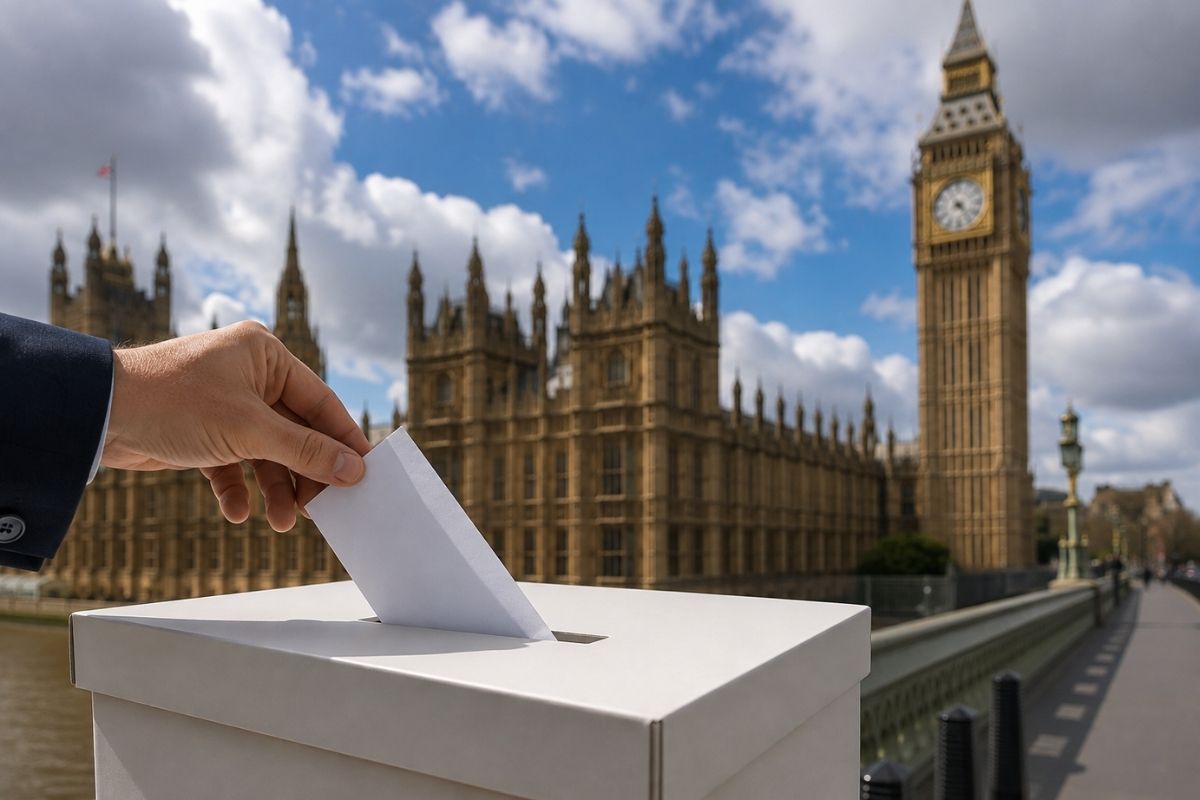
Quick answer: Not really. UK law sets five years as the maximum length of a Parliament. It isn’t a promise of an election every five years, and it never has been. Since 1900, Parliament has actually run its full term only a handful of times. Most elections come early, called whenever the sitting Prime Minister decides the political weather suits them.
The current Parliament, elected on 4 July 2024, has to be dissolved by 9 July 2029 at the very latest, with polling day following within 25 working days of that. So the outer limit for the next general election is 15 August 2029 — but that’s a ceiling, not a booking.
That distinction, ceiling versus schedule, is where most explanations of this topic go wrong. Below is the full picture: how the current rules work, why an older version of them collapsed within a decade, and what’s changed in UK politics since, including the change of Prime Minister in the summer of 2026.
- UK law caps a Parliament at five years, but that’s a ceiling, not a guaranteed election cycle.
- The Prime Minister can call an early election almost any time within that five-year window.
- Since 2015, actual gaps between elections have run from about 2 to 4.5 years, rarely the full five.
- A change of PM — like Andy Burnham replacing Keir Starmer in July 2026 — doesn’t trigger an election on its own.
- The next UK general election must happen by 15 August 2029 at the latest.
Key Facts at a Glance
| Question | Answer |
| Legal maximum length of a UK Parliament | 5 years from the day it first meets |
| Is 5 years a required interval? | No — an election can be called earlier at any time |
| Law currently governing dissolution | Dissolution and Calling of Parliament Act 2022 |
| Who can trigger dissolution | The Prime Minister, by requesting the monarch dissolve Parliament |
| Date the current Parliament first met | 9 July 2024 |
| Automatic dissolution date (if no early election) | 9 July 2029 |
| Latest possible date for the next general election | 15 August 2029 |
| Last general election | 4 July 2024 |
| Must elections be held on a Thursday? | No legal requirement, but a convention since 1935 |
| Current Prime Minister (as of September 2026) | Andy Burnham, who took office 20 July 2026 |
Also Read: Royal Family Protocols: Do Royals Need a Passport to Travel?
What The Law Actually Says
A UK Parliament automatically expires, and has to be dissolved, five years after the day it first met — unless it’s dissolved sooner. That’s the rule under the Dissolution and Calling of Parliament Act 2022, which is the law currently in force. Once dissolution happens, a general election has to follow within 25 working days. No exceptions, no extensions.
The 2022 Act did something else too. It put the power to trigger an early dissolution back in the Prime Minister’s hands. In practice that means the PM can ask the monarch to dissolve Parliament pretty much whenever they like within that five-year window. A good run of polling. Pressure from their own backbenchers. A crisis they’d rather put to voters than manage alone. Any of it can be reason enough.
So if someone asks whether the UK holds an election every five years, the honest answer is: five years is how long a Parliament is allowed to last, not how often elections happen. And the clock resets each time — it starts from the day the new Parliament first sits, not from the date of the previous vote.
Why This Needs Explaining At All: The Fixed-term Parliaments Act saga
For about a decade, UK election timing genuinely did look more like a fixed five-year clock. It didn’t last.
The Fixed-term Parliaments Act 2011 was brought in by the Conservative–Liberal Democrat coalition specifically to stop prime ministers cherry-picking the most convenient moment for an election. It set polling day as the first Thursday in May, every five years, and made early elections deliberately hard: either a two-thirds vote of MPs, or a failed no-confidence motion followed by a 14-day window in which no alternative government could be cobbled together.
It worked exactly once. The 2015 election landed right on schedule, as planned. Then it got bypassed twice in quick succession:
- April 2017: MPs voted 522 to 13 to trigger an early election. Polling day landed on 8 June 2017, roughly two years ahead of schedule.
- October 2019: after repeated failures to hit the two-thirds threshold, Parliament sidestepped the FTPA altogether and passed one-off legislation — the Early Parliamentary General Election Act 2019 — to force a vote on 12 December 2019.
Having been outmanoeuvred twice in a row, the Act was formally repealed on 24 March 2022. Its replacement, the Dissolution and Calling of Parliament Act 2022, brought back the older approach: dissolution as a power the monarch exercises on the Prime Minister’s advice, with a hard five-year backstop and nothing in between.
Also Read: Facts Check: Is Prince Harry Planning to Return to the UK Every Few Months?
So How Often Have Elections Actually Happened?
The real gaps between elections make the point better than any legal summary. Here’s the run since the FTPA era began:
| Election | Gap from Previous Election |
| 2015 | 5 years — ran the full fixed term |
| 2017 | ~2 years — snap election |
| 2019 | ~2.5 years — snap election |
| 2024 | ~4.5 years |
Go back further and it’s the same story. 1951, 1955, 1959, 1964, 1966, 1970, then two elections in a single year in 1974, then 1979, 1983, 1987, 1992, 1997, 2001, 2005, 2010. A full five-year term has always been more the exception than the rule. When a government has a comfortable majority and decent poll numbers, history suggests it goes early far more often than it waits.
Who Actually Decides When An Election Happens?
Since 2022, that decision sits with the Prime Minister of the day, full stop. They ask the monarch to dissolve Parliament, and by long-standing convention, that request is granted — no Commons vote required, no supermajority to clear, none of the FTPA’s old hurdles. The only real constraint is the five-year backstop. The PM can’t go past it, but they’ve got plenty of room to move well within it.
Worth clearing up a misconception here too: a change of Prime Minister does not, on its own, trigger a general election. Voters in the UK elect MPs to the House of Commons, not a head of government directly. Whichever party (or coalition) holds a Commons majority picks its own leader, and that person becomes Prime Minister without any fresh national vote being needed. Which is more or less exactly what happened in the summer of 2026.
The 2026 Leadership Change, and Why It Hasn’t Reset Anything
This is the part that’s turned “when’s the next UK election” back into a live question in 2026, so it’s worth laying out plainly.
Keir Starmer led Labour to a landslide in July 2024, but his time in office got rockier from there: weak polling, a rough set of local election results in May 2026, and growing pressure from his own MPs. On 22 June 2026 he announced he intended to resign, both as Labour leader and as Prime Minister. Andy Burnham, until then Mayor of Greater Manchester, had returned to the Commons weeks earlier after winning the Makerfield by-election, which made him eligible to run. Nominations opened on 9 July, and Burnham ended up with the backing of the overwhelming majority of Labour MPs — he became party leader unopposed on 17 July 2026 and was sworn in as Prime Minister on 20 July, the UK’s seventh PM in a decade.
None of that required, or produced, a general election. Labour kept its Commons majority throughout the whole transition. The legal deadline for the next election didn’t move an inch: still no later than 15 August 2029.
What the leadership change does affect is the political calculation around timing, not the legal one. Burnham now faces the same choice every incoming PM does: run the full term, look for an earlier mandate once his own government has had time to settle in, or hold out for as long as possible given Reform UK’s persistent polling lead through 2025 and into 2026. Nothing in law pushes him either way before 2029.
Also Read: The State Pension Age Is Increasing to 67 — Are You Affected?
Do UK General Elections Have To Be Held On a Thursday?
No, there’s no statute requiring it. It’s pure convention, though a remarkably consistent one: every UK general election since 1935 has fallen on a Thursday. The reasons usually offered range from market days and pay days to just avoiding the mess of a weekend or a Monday-morning scramble — but none of it is written into law. It’s tradition doing the work that legislation doesn’t.
Frequently Asked Questions
Does the UK hold a general election every five years?
Not automatically. Five years is the legal maximum a Parliament can run, and elections are called earlier far more often than they aren’t, usually at the Prime Minister’s own discretion.
What is the maximum length of a UK Parliament?
Five years, counted from the day Parliament first meets — not from the date of the previous election.
Who has the power to call an early general election?
The Prime Minister does, by requesting the monarch dissolve Parliament under the Dissolution and Calling of Parliament Act 2022. By convention, that request is always granted.
When must the next UK general election be held by?
By 15 August 2029 at the latest. The current Parliament first met on 9 July 2024, so it has to be dissolved within five years of that date, and polling day follows within 25 working days of dissolution.
Why don’t UK elections happen exactly five years apart?
Because the five-year rule was only ever meant as a backstop. Governments with strong majorities or good polling have gone early again and again — 2017 and 2019 are the recent examples, but it’s been the pattern for most of the last century.
Did Andy Burnham becoming Prime Minister in 2026 trigger an election?
No. He became PM by winning Labour’s internal leadership contest after Keir Starmer resigned, and Labour never lost its Commons majority during the handover. A change of party leader isn’t a trigger for a general election in the UK system.
Is there a legal requirement for elections to fall on a Thursday?
No — it’s convention rather than law, but it’s held for every general election since 1935.
What was the Fixed-term Parliaments Act, and why was it scrapped?
A 2011 law that tried to lock in five-year terms with a set May election date and strict conditions for early votes. Early elections in 2017 and 2019 got around it anyway, and it was repealed in March 2022.
Sources consulted: UK Parliament (parliament.uk), GOV.UK, the Dissolution and Calling of Parliament Act 2022, House of Commons Library briefings, and contemporaneous reporting on the 2026 Labour leadership transition.