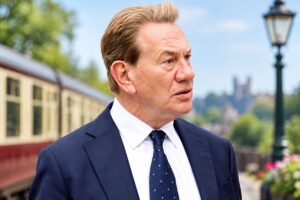
Quick Answer: Michael Portillo is a former Conservative Cabinet minister turned TV presenter. Born in 1953 to a Spanish refugee father, he ran Defence under John Major, lost his seat in the 1997 landslide, and now makes railway travel programmes.
Pink jackets, mustard trousers, and a battered Victorian guidebook. That’s the bloke most of us picture now. He also used to run the Ministry of Defence.
- Born 26 May 1953 in Bushey, Hertfordshire, and is now 73. Spanish father, Scottish mother.
- Tory MP for Enfield Southgate (1984–1997), then Kensington and Chelsea (1999–2005).
- Held three Cabinet jobs: Treasury, Employment, and Defence.
- His 1997 defeat gave us “the Portillo moment”.
Fact 1: His First Screen Job was Flogging Squash
There was Ribena, long before the select committees. In 1961, aged eight, he appeared in a telly advert for the blackcurrant drink, a detail logged on his Wikipedia.
Fact 2: His Passport Says Miguel
He was made a Spanish citizen at four. Spanish naming rules want two surnames, so his passport reads Miguel Portillo Blyth, the second from his Scottish mum.
His father, Luis Gabriel Portillo, taught law at Salamanca and advised the Republican government on death sentences, quietly commuting them. He fled Madrid in 1939 when Franco won and was such a pacifist that he went to the front unarmed. His mother’s father was a rich Kirkcaldy linen maker who left the town an art collection worth millions.
Also Read: Does the UK Hold a General Election Every Five Years? The Facts Explained
Fact 3: There was a Harold Wilson Poster on His Bedroom Wall
At school he was a Labour supporter. It changed at Peterhouse, Cambridge, where the right-wing historian Maurice Cowling taught him. In a long chat with High Profiles, he blamed atmosphere rather than books, naming only Burke and John Stuart Mill.
He took a first in 1975, did a dull stint at a shipping firm, then asked Cowling what to do next. Cowling said it was a pity he wasn’t interested in politics. He said he was interested in politics and joined the Conservative Research Department in 1976.
Fact 4: The Thing He’s Proudest of is a Railway Line
As Transport Minister from 1988 to 1990, he decided whether to shut the Settle–Carlisle line. He kept it open and still considers it his greatest achievement in office. It was something that had value, he says. In 2018 he became President of the Friends of the Line after Sir William McAlpine died.
Fact 5: There’s a Locomotive With His Name on It
Class 66 number 66719 carries a Michael Portillo nameplate, unveiled at the Greatest Gathering in Derby in 2025.
From Party Researcher to the Cabinet Table
He fought Birmingham Perry Barr in 1983 and lost to Jeff Rooker. Then came the Enfield Southgate by-election of December 1984, called after Sir Anthony Berry died in the IRA’s Brighton bombing.
UK Parliament records show the climb: assistant whip in 1986, a junior social security job in 1987, then transport, then local government. He was transport minister when the Marchioness sank in 1989, killing 51 people, and later defended the poll tax, which he now calls a mistake, though not a sin.
Thatcher backed him early, reportedly saying that she expected exceptional things from him and that he would not disappoint. He reached the Cabinet in 1992 and joined the Privy Council, making him “The Right Honourable” for life.
| Role | Years |
|---|---|
| Chief Secretary to the Treasury | 1992–1994 |
| Employment Secretary | 1994–1995 |
| Defence Secretary | 1995–1997 |
Also Read: How Can You Get Cheap Train Tickets in the UK? 9 Ways to Save
The Portillo Moment
At Defence he pushed for “clear blue water” between the Tories and Labour, borrowed the SAS motto “Who Dares Wins” for a conference speech, and sold the MoD’s housing stock to Annington Homes in 1996. Critics called him vain for booking Alexandra Palace to mark ten years in politics. Private Eye nicknamed him Portaloo.
In 1995 he nearly ran against John Major. He set up banks of phone lines, then didn’t stand. He later admitted he looked happy to wound but afraid to strike.
Then came 1 May 1997. Stephen Twigg took the seat on a 17.4% swing. A profile on Politics.co.uk notes that every big scalp since has measured itself against that night. He’d guessed it from the exit poll and chose to lose with dignity, later writing that he felt lucky to be chucked out.
Comeback, Confession, and 2001
In 1999 he told The Times, “I had some homosexual experiences as a young person.” His wife, Carolyn Eadie — a recruitment consultant he married at Harrow Register Office in 1982 — already knew, though she wasn’t warned about the interview. They’re still together after four decades, having come through her breast cancer early on.
Weeks later, Alan Clark’s death opened up Kensington and Chelsea. He won it that November, then became Shadow Chancellor under William Hague, accepting Bank of England independence and the minimum wage in his first weekend. He ran for leader in 2001, finishing third behind Iain Duncan Smith and Ken Clarke. He backed the Iraq War, turned down a job from Michael Howard, and then quit in 2005.
Trains, Travel, and Telly
Great British Railway Journeys began in January 2010, built around George Bradshaw’s 1863 handbook, and has run to sixteen series. Continental, American, Indian, Alaskan, Canadian, Australian, Asian, Japanese and Korean versions followed. The Central Asian one, tracing the Silk Road through Uzbekistan, landed in May 2026.
He sat on This Week with Andrew Neil and Diane Abbott — the two were at neighbouring schools and once shared a stage in Romeo and Juliet, neither of them in the lead. He’s chaired the Man Booker judges, sits on The Moral Maze, made documentaries on capital punishment and mental health, backed Brexit, and hosts Portillo on GB News.
Off Duty: Doubt, Charity and an Awkward Taxi
He calls himself beyond a lapsed Catholic and leans towards atheism, though he walked part of the Camino to Santiago in 1999 for a newspaper piece. He chairs the Federation of British Artists, ran the £36m Catalyst Arts Fund, and is president of the skin charity DEBRA. In 2019 he led the sheep drive over London Bridge.
Best story? He once shared a two-hour taxi in Morocco with John Profumo, both of them avoiding the obvious.
Also Read: The State Pension Age Is Increasing to 67 — Are You Affected?
Frequently Asked Questions
How old is Michael Portillo?
Ans: He was born on 26 May 1953, which makes him 73. He grew up in Bushey, Hertfordshire.
What is the “Portillo moment”?
Ans: His shock 1997 defeat in Enfield Southgate. The phrase now covers any big name losing their seat live on air.
Is he still married?
Ans: Yes, he has been married to Carolyn Eadie since 1982. They have a holiday home in Andalusia.
Why does he wear such loud clothes?
Ans: It started as a TV wardrobe choice and has stuck ever since. Bold colours, he says, put him in the mood for adventure.
Which railway shows does he present?
Ans: The Great Railway Journeys family, covering Britain, Europe, America, Asia and beyond.
Is he still a Conservative MP?
Ans: No. He stood down in 2005, and his party membership has since lapsed.
Sources & References:
- UK Parliament – He was assistant whip in 1986, a junior social security job in 1987, then transport, then local government.