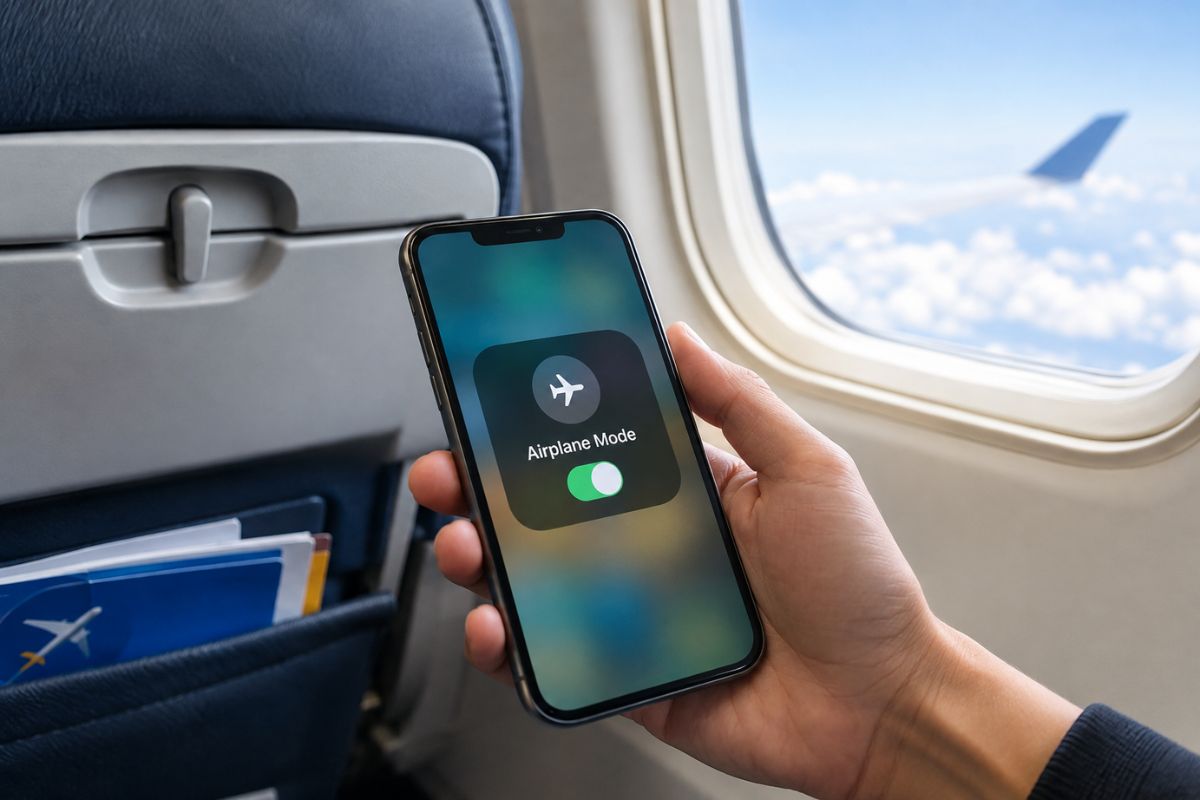
Short answer: Yes. Airplane mode is still required by law on almost every flight in the world. But the real reason has changed over time. The old fear was that one phone could bring down a plane. That was never really backed by strong evidence. Today, the rule sticks around for a few smaller reasons: a small radio risk during takeoff and landing, extra strain on cell networks below, buzzing in pilots’ headsets, and plain old regulatory habit. So just turn it on. It costs you nothing, and it keeps you out of trouble.
That short answer skips a lot, though. A debate about this exact question went viral again in early 2026. It’s also something aviation and tech writers have argued about for more than ten years. Here’s the full story, checked against the facts.
- Airplane mode is still legally required on almost all flights worldwide, even though a single phone was never proven to actually crash a plane.
- The real interference risk is tiny and mostly limited to takeoff and landing, not cruising altitude.
- The rule survives mainly for practical reasons — legal compliance, network strain, battery drain, and preventing “air rage” — not hard safety proof.
- The EU allowed 5G in-flight connectivity starting in 2023, but most airlines worldwide, including in the U.S., still require airplane mode.
- In 2026, airlines like British Airways are enabling calls over Wi-Fi (via Starlink), showing connectivity is expanding through Wi-Fi rather than cellular networks.
A Decade-Old Question Went Viral Again in 2026
In March 2026, a post on Threads brought the airplane mode debate back to life. It got replies from travelers, flight attendants, and even working pilots. The original poster said airplane mode isn’t really about crashes. It’s about stopping your phone from acting “feral” at cruising speed — constantly searching for cell towers it can never reach.
What made the thread interesting wasn’t the original claim. It was who agreed with it. Several pilots said they hadn’t heard phone interference over the radio in years, if ever. Some admitted they never switch their own phones to airplane mode. One aviation engineer, who said he used to certify aircraft equipment, explained it simply: the real risk window is small. It mostly happens during takeoff and landing, because that’s when navigation and radio gear are working hardest in the busiest, lowest airspace.
That gap — between “in theory, this could happen” and “your phone will crash the plane” — is the heart of almost every serious report on this topic in the last two years. It’s worth separating the facts from the myth.
Also Read: 8 Mixed Reality Experiences You Need to Try in the UK Right Now
Where the Rule Actually Came From
The airplane mode rule didn’t start as a safety rule at all. It started as a telecom rule. In 1991, the U.S. Federal Communications Commission (FCC) banned cellphone use on flights. The reason given was to protect cell networks on the ground, not the plane itself. A phone moving fast at altitude can connect with dozens of towers at once. Back in the older, analog-network days, that really could jam cell service below.
That ground-network reason became outdated faster than most people realize. By 2005, an FAA official told Congress that newer cellphone technology meant the FCC’s ban might not even be needed anymore to protect ground networks. In 2013, then-FCC chairman Tom Wheeler tried to officially lift the ban. He argued the old rule no longer matched today’s technology. That plan fell apart — not over safety concerns, but because people didn’t want to sit next to someone taking loud phone calls at 35,000 feet. His successor, Ajit Pai, dropped the idea for good in 2017. Nothing has changed since.
So here’s the honest history for U.S. flights: the safety case for airplane mode was always weaker than most passengers assumed. The rule has stuck around less because of strong engineering proof, and more because no regulator wants to be blamed if something ever goes wrong — even if a phone had nothing to do with it.
Is There Still a Real Interference Risk?
A little. But it’s smaller and narrower than the pre-flight announcement makes it sound.
- During takeoff and landing: This is when the plane flies closest to the ground, through the busiest airspace, and relies most on precise navigation and radio contact. Engineers who’ve worked on aircraft certification say this is the only time radio signals from phones carry even a small, theoretical risk to cockpit instruments.
- During cruise: Several aviation experts, including people who’ve worked on aircraft shielding, say modern planes are well protected. Once a flight levels off, a phone searching for signal at 35,000 feet has almost no way to disturb flight systems.
- The FAA’s own research backs this up. A 2012 FAA-funded study looked for confirmed cases of phones disturbing aircraft. It found almost no solid proof — despite years of loose, anecdotal pilot reports blaming passenger devices.
- The headset buzz is real, but it’s just annoying. Pilots and frequent flyers describe a faint electronic buzz in headsets when a phone searches for or connects to signal near the cockpit. It sounds like the noise you get when a phone sits too close to a speaker. It’s annoying, not dangerous.
Also Read: Does Incognito Mode Really Hide Your Browsing History?
The Reasons the Rule Persists Aren’t Really About Crashing
If the safety risk is this small, why hasn’t the rule gone away? A few practical reasons keep it in place. None of them are dramatic — they’re mostly bureaucratic.
- It’s still the law, no matter what the physics say. In the U.S., an FAA guidance document tells passengers to follow crew instructions, and that includes switching devices to airplane mode. Ignoring a crew instruction counts as breaking federal rules. The FAA has fined people for exactly this. The rule doesn’t need airtight science to stay legally binding.
- Ground networks still feel some strain. A phone not in airplane mode keeps searching for and briefly linking to several towers as the plane flies overhead at high speed. Multiply that across a full cabin, and it adds real, if small, pressure on cell networks below — mostly a headache for phone carriers, not the plane.
- Battery drain and heat. Even without any safety angle, a phone hunting endlessly for signal drains its battery fast and can run warm. That alone is a good reason to switch it on.
- Cabin etiquette and “air rage.” This might be the most honest reason of all. Regulators and airlines have admitted that letting everyone make calls in a packed metal tube is more of a behavior problem than a safety one. The FAA has tracked a sharp rise in unruly-passenger incidents over several years. Airlines have little interest in reopening that fight.
The Rest of the World Is Moving Faster Than the U.S.
This is where things have actually changed in recent years — and it’s the part most older “is airplane mode necessary” articles miss.
In late 2022, the European Union ruled that airlines could offer full 5G connectivity in the air. This uses small onboard devices called pico-cells, which send calls, texts, and data through a satellite link to the ground network without disturbing regular cell towers. The European Commission set a deadline of June 30, 2023 for EU countries to free up the needed frequency bands. The logic: in-flight 5G uses different frequencies than the ones planes use for navigation and radio contact, so the interference risk drops sharply.
In real life, though, adoption has been slower than that 2023 deadline suggested. Most airlines still need pico-cell equipment installed across their fleets before they’ll drop the airplane mode rule. Many are also cautious about fully unrestricted phone calls, for the same “air rage” reasons mentioned above.
The bigger shift in 2026 has come through Wi-Fi, not cellular service. British Airways became one of the first big airlines to openly allow voice and video calls over its in-flight Wi-Fi, after rolling out free Starlink internet in March 2026. It plans to expand this across its whole fleet by 2028. Other big carriers — including United and Alaska — are installing Starlink-powered Wi-Fi too, but so far haven’t changed their call rules. That means whether you can make a call still depends on the airline, not just the technology.
Bottom line for travelers: outside a small, growing list of 5G-equipped European routes and Wi-Fi-calling flights, airplane mode is still the default rule almost everywhere — including all U.S. domestic flights.
What Actually Happens If You Forget
Nothing dramatic, almost every time. Modern planes are well shielded. Crews rarely check every phone after boarding. And there’s really no way for anyone to know your phone stayed in normal mode once it’s back in your pocket. But “nothing dramatic happens” isn’t the same as “nothing happens”:
- Your battery drains faster, since your phone keeps searching for and losing signal.
- You might add to a faint buzz in the cockpit crew’s headsets during parts of the flight.
- You’re technically breaking a federal rule to follow crew instructions, which carries a small risk of a fine if a crew member notices and decides to act on it.
- You gain almost nothing for the risk, since most flights now offer Wi-Fi that covers everything you’d actually want a live connection for.
Also Read: Does Two-Factor Authentication Really Stop Hackers? The Truth
Frequently Asked Questions
Is airplane mode a legal requirement or just an airline courtesy?
Both, depending on where you fly — but in the U.S., it’s the law. FAA guidance tells passengers to follow crew instructions, which includes device settings during the flight. Ignoring this can count as breaking a federal rule.
Can phones actually interfere with a plane’s navigation systems?
The risk is real but very small. It’s mostly limited to takeoff and landing, not cruise altitude. Aviation engineers and a 2012 FAA-backed study found little to no solid proof that cellphones disturb flight systems on modern, shielded planes.
Do pilots actually use airplane mode themselves?
It varies. Some pilots who spoke up during the 2026 Threads debate said they skip it personally and haven’t noticed interference in years. This is informal, personal practice — not an official policy change.
Has any country actually eliminated the airplane mode rule?
Not fully. The European Union allowed 5G-based in-flight connectivity starting in 2023, letting properly equipped airlines permit calls, texts, and data use. But most airlines worldwide — including nearly all in the U.S. — still require airplane mode for the whole flight.
Will airlines let passengers make phone calls in the future?
Some already do, through Wi-Fi rather than cell networks — British Airways is a clear 2026 example. Most major airlines, including United and Alaska, are adding satellite Wi-Fi but haven’t changed their call rules yet, mainly due to cabin-etiquette concerns rather than safety.
The Bottom Line
Airplane mode was never really about your phone bringing down a plane. Aviation engineers, FAA data, and even pilots agree the real interference risk is tiny, and mostly limited to takeoff and landing. But “tiny risk” doesn’t mean “no rule.” The rule is still here. Until regulators rewrite it worldwide — something the EU has started, but the U.S. hasn’t shown much interest in — airplane mode stays a legal instruction, not a suggestion. It takes one swipe. It saves your battery. It spares the cockpit crew a headache. And it keeps you out of a conversation with a federal regulator you’d rather avoid. Flip the switch.
Sources: Federal Aviation Administration advisory circular AC 91.21-1D; Federal Communications Commission rulemaking history; a 2012 FAA-commissioned interference study; InsideHook (March 2026); Gizmodo (2024); Booking.com Travel Guides; AirClaim; European Commission 5G-on-aircraft ruling (2022–2023); airline in-flight connectivity announcements (2026).