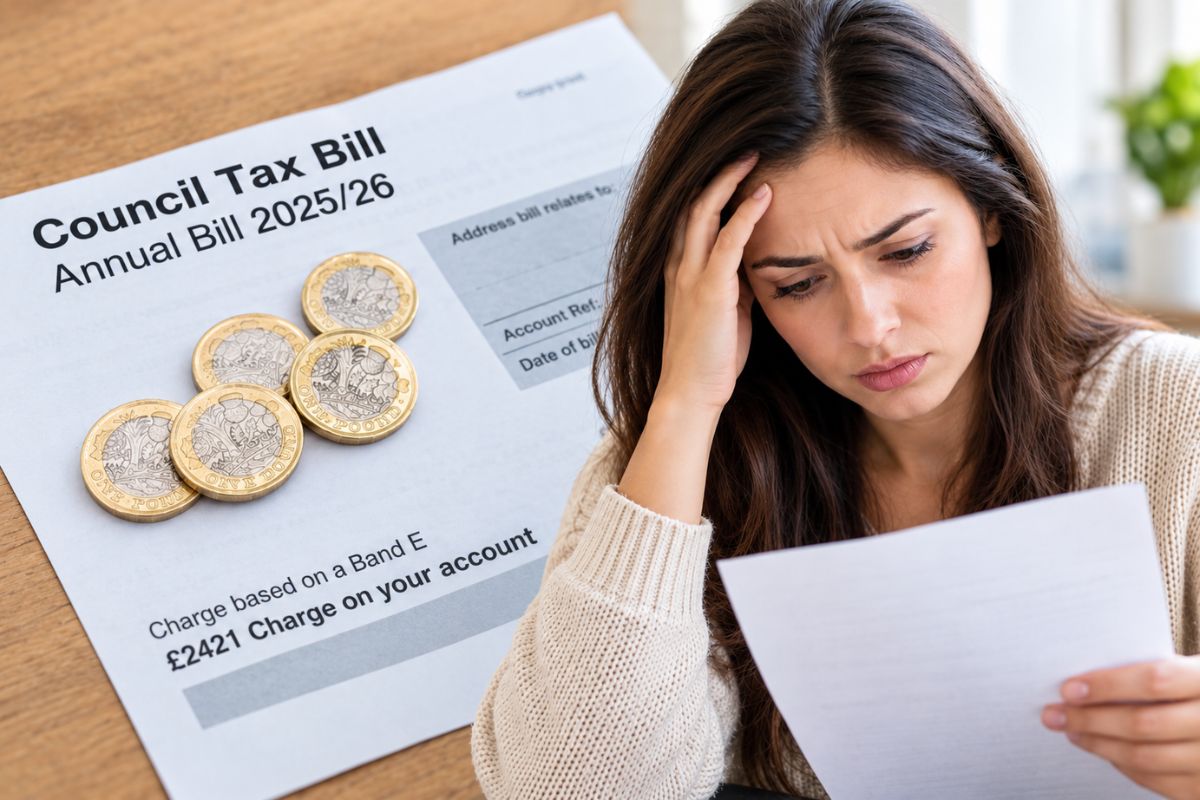
Checking takes less than a minute and costs nothing. Enter your postcode on the GOV UK band checker for England and Wales, or the Scottish Assessors Association site for Scotland. There is no account to create, no password, and no bill reference required.
Plenty of people assume working out how I find out the council tax band means phoning the council or digging out an old statement. It doesn’t. Valuation lists are public records, so you can look up your own home and your neighbours’ homes in the same sitting.
- Band checks are free, public and need no login.
- England and Scotland still use 1 April 1991 property values. Wales uses 1 April 2003.
- There are eight bands (A–H) in England and Scotland, and nine (A–I) in Wales.
- Your band is also printed on your annual bill.
- Northern Ireland has no bands at all. It uses domestic rates.
- A successful challenge can be backdated to 1993.
What is a Council Tax Band?
Council tax arrived in 1993 under the Local Government Finance Act 1992, replacing the community charge, or “poll tax”. Every self-contained home was placed in a band based on what it would have sold for on a fixed past date.
Your band does not reflect today’s market price. A flat bought last year for £400,000 may sit in Band C because its notional 1991 value was low.
Bands are set by the Valuation Office in England and Wales, a part of HM Revenue & Customs since the Valuation Office Agency was folded into HMRC in April 2026, and by Scottish Assessors north of the border. Your local council does not choose your band. It only sets the rate charged for each band.
Also Read: Does the UK Hold a General Election Every Five Years? The Facts Explained
How To Check Your Band With No Login
Step 1: Pick the right service. For England and Wales, the GOV UK council tax band checker is the official route, and it also runs in Welsh. For Scotland, use the Scottish Assessors Association portal.
Step 2: Type your postcode. You will see a list of every address in that postcode. Choose yours.
Step 3: Read the band letter. The result shows the band, plus whether an improvement or review is pending.
Step 4: Check the neighbours while you are there. Same postcode, same screen. This is the most useful thing you can do in one visit.
Step 5: Find your charge. Your band letter alone is not a figure. Your council publishes the pounds and pence. Brent Council, for example, lists a Band D bill of £2,235.27 for 2026–27 against £2,133.15 the year before. Rates differ hugely between authorities.
Prefer paper? Your band sits on your bill. Citizens Advice also points out that the valuation list can be inspected at your council’s main offices, and sometimes at the local library, though a small charge may apply.
Band Values At a Glance
| Band | England (1991) | Scotland (1991) | Wales (2003) |
| A | Up to £40,000 | Up to £27,000 | Up to £44,000 |
| B | £40,001–£52,000 | £27,001–£35,000 | £44,001–£65,000 |
| C | £52,001–£68,000 | £35,001–£45,000 | £65,001–£91,000 |
| D | £68,001–£88,000 | £45,001–£58,000 | £91,001–£123,000 |
| E | £88,001–£120,000 | £58,001–£80,000 | £123,001–£162,000 |
| F | £120,001–£160,000 | £80,001–£106,000 | £162,001–£223,000 |
| G | £160,001–£320,000 | £106,001–£212,000 | £223,001–£324,000 |
| H | Over £320,000 | Over £212,000 | £324,001–£424,000 |
| I | — | — | Over £424,000 |
Band D is the national yardstick. Wikipedia records the statutory ratios neatly: Band A pays six-ninths of the Band D figure and Band H pays twice it, with no cap above Band H. Scotland changed its top four multipliers in April 2017, so Band H there pays 245% of Band D.
New Builds and Missing Records
If your home did not exist on the valuation date, it is still given a notional value for that date by comparing it with similar local properties. Size, layout, character, location and any change of use all feed in.
Occasionally an address returns nothing. Property Checker suggests three practical fixes: ring the council, look at an older bill, or ask the current occupier or owner. A handful of properties are genuinely missing from the database, and the council can explain why.
Also Read: Does Buy Now Pay Later Affect Your Credit Score in the UK? The 2026 Guide
Why are So Many Bands Wrong?
Here is the part most people never hear. In 1991 the job was enormous and the deadline short, so estate agents and others were drafted in to help. Many homes were banded from the kerb without anyone stepping out of the car.
Money Saving Expert, where Martin Lewis has campaigned on this since 2007, describes these as “second-gear valuations” because the valuers “mostly didn’t stop their cars, never mind got out of them”. England and Scotland have never had a full revaluation since.
Wales did have a full revaluation in 2005, using 2003 prices, which is why Welsh bands are far less likely to be wrong. Hundreds of thousands of homes are still thought to sit in the wrong band.
Do Two Checks Before You Challenge
The neighbours check. Are identical homes near you in a lower band? If so, you may have a case. But it could also mean they are all banded too low. One Hull street learnt this the hard way: the challenger’s band stayed put and her neighbours went up instead.
The valuation check. Estimate what your home was worth in 1991. Which? recommends pulling a recent sale price from Rightmove or Zoopla, then running it through the Nationwide house price calculator to work backwards. Compare the result with the table above. It is not evidence, but it tells you whether you are on solid ground.
Only proceed if you pass both. You cannot ask for a lower band — only a review — and reviews go both ways.
How to Challenge and What You Get Back
A formal challenge is normally open to you if you have lived there six months or less, or if the property or the area has materially changed. Beyond that window in England and Wales, you can request an informal review, where the burden of proof sits with you. Scotland has no informal route.
Ask the Valuation Office for your property attribute data first. It is free, and errors in floor area, property type, or room count are common. Call 03000 501 501 in England or 03000 505 505 in Wales. Then submit up to five genuinely comparable addresses in lower bands — same street, similar age, style and size, all within roughly 10%.
Expect acknowledgement inside 28 days, a formal decision within six months, and up to twelve for an informal review. If you are refused and disagree, the Valuation Tribunal hears appeals free of charge within three months in England. Welsh refusals are reviewed automatically. In Scotland, you have around six months to appeal to the Local Taxation Chamber.
If you win, your monthly payments drop often by £100 to £400 a year, and you are refunded back to your move-in date or 1993, whichever is later. Payouts of £1,000s are common.
Don’t Forget Discounts
Your band is only half the bill. Live alone and you get 25% off. All-student households pay nothing. If your home has been adapted for a disabled occupant, it drops one band, and Band A homes get 17% off instead. Low income may qualify you for Council Tax Reduction, applied for through your council.
Also Read: How Much Does the Average UK Pension Pay Monthly in 2026?
Frequently Asked Questions
How do I find out my council tax band for free?
Ans: Enter your postcode on the GOV UK band checker or the Scottish Assessors site if you live in Scotland. It is free, instant and needs no login or account.
Can I check someone else’s council tax band?
Ans: Yes. Valuation lists are public, so any address in England, Scotland or Wales can be looked up by postcode. This is how you compare your band with your neighbours’.
Is my council tax band based on what my house is worth now?
Ans: No. England and Scotland use 1 April 1991 values, Wales uses 1 April 2003. Recent sale prices have no direct effect on your band.
Why is my band higher than my neighbour’s identical house?
Ans: Most 1991 valuations were done quickly from the roadside, so errors persist. Either your band is too high or theirs is too low. Check both before challenging.
Will improving my home push me into a higher band?
Ans: Not immediately. Extensions and improvements usually only trigger a review when the property is sold or re-leased for over seven years.
How do I find my council tax band in Northern Ireland?
Ans: You can’t. Northern Ireland never adopted bands. Bills use domestic rates based on your property’s capital value, multiplied by your area’s rate percentage.
Sources & References
- Money Saving Expert – Martin Lewis has campaigned on this since 2007.
- Citizens Advice – The valuation list can be inspected at your council’s main offices and sometimes at the local library, though a small charge may apply.
- Wikipedia – Band A pays six-ninths of the Band D figure and Band H pays twice it, with no cap above Band H.