Verdict: Unverified
Sort of, but not like the books say. Trees and fungi swap sugar and nutrients. Fungal threads can link the roots of different plants. What scientists haven’t shown is that trees use these links to warn each other or feed their young in real forests. The network is real. The “talking” is still unproven.
- Fungal networks under forests are real, and they trade sugar, water, and nutrients with tree roots.
- Carbon can move between nearby trees, but it’s often unclear whether fungi carry it.
- No field study has shown that trees warn each other or feed their young through these networks.
- Newer studies suggest fungi may hold onto the carbon, and plants may listen in rather than send helpful alerts.
- Protecting soil fungi still matters, since they help trees grow and store carbon.
What Is The “Wood Wide Web”?
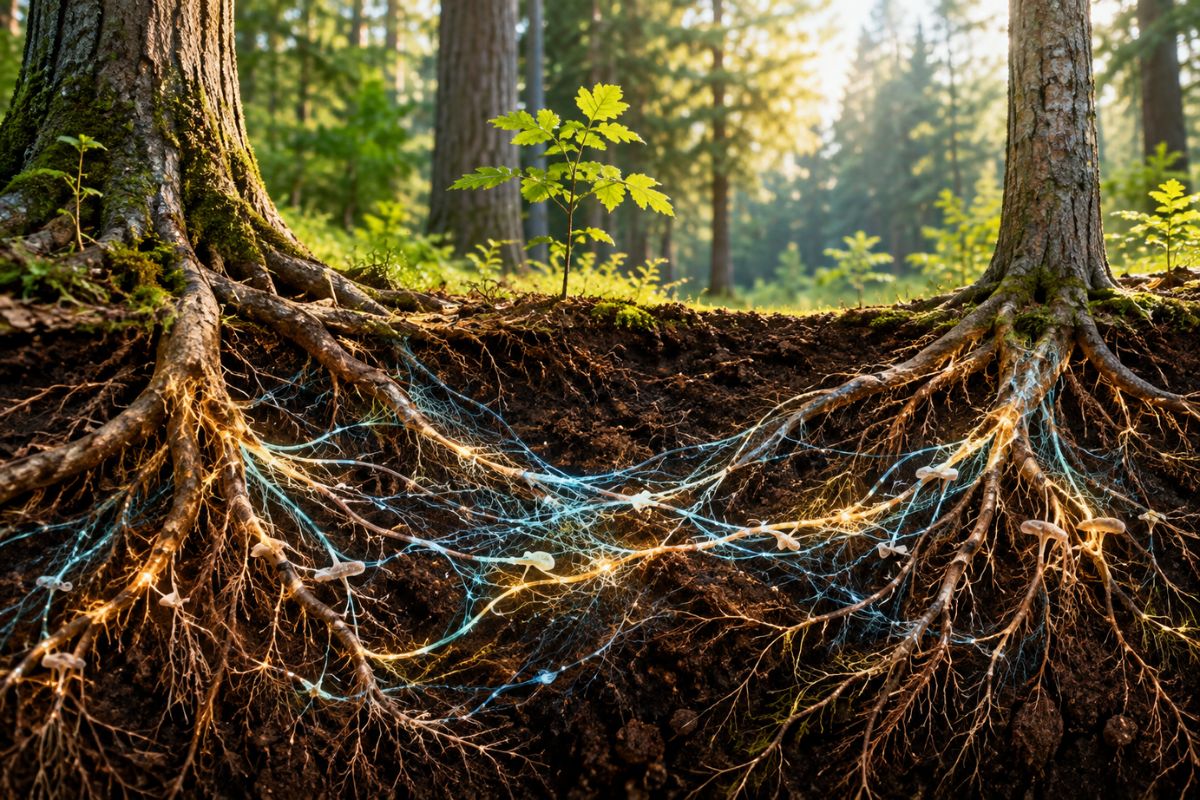
Most trees have a partner in the soil: a fungus. This partnership is called a mycorrhiza. The fungus grows tiny threads, called hyphae, around the roots. The threads pull minerals out of the soil for the tree. In return, the tree feeds the fungus sugar.
Sometimes one fungus connects the roots of several plants. Scientists call that a common mycorrhizal network, or CMN. The public calls it the “wood wide web.”
Two people made the idea famous. Peter Wohlleben, a German forester, wrote The Hidden Life of Trees, which became a bestseller in many countries. Suzanne Simard, a forest ecologist, wrote Finding the Mother Tree in 2021. She says big, old “mother trees” sit at the center of the network and help the young trees around them. Her 1997 work, which showed carbon moving between birch and Douglas fir, is the base of that story.
What Supports The Idea
Some of the evidence is solid.
- Carbon can move between trees. In a 2016 Swiss study, scientists sprayed a carbon marker on some leaves. Later they found it in nearby trees that were never sprayed.
- Fungi matter a lot. They bring water and nutrients to trees, guard roots against disease, and help store carbon. No one argues with this.
- Trees do send chemical signals. When caterpillars chew on elms and pines, the trees sense the caterpillar’s saliva. They release scents that call in wasps, and the wasps attack the caterpillars. That signal travels through the air, not the soil.
Also Read: Do We Really Only Use 10% of Our Brain? Here’s What the Science Says
What The 2023 Review Found
In 2023, three scientists published a review in Nature Ecology & Evolution. They were Justine Karst of the University of Alberta, Melanie Jones of UBC Okanagan, and Jason Hoeksema of the University of Mississippi. They checked three popular claims against real field studies.
Claim 1: These networks are everywhere in forests. The team found only five studies that mapped fungi by DNA across trees. Those studies covered just two forest types. Also, fungal links break easily. A DNA sample is a snapshot, so it can’t prove two trees are still connected.
Claim 2: Mother trees feed seedlings through the network. The team looked at 26 studies. Resources can move through the ground, but not always through fungi. Most seedlings didn’t gain anything from the connection. Jones said that in the best-controlled tests, fewer than 20 percent of seedlings did better.
Claim 3: Trees warn each other through fungi. The team found no published field study to back this up. The one related test used potted seedlings in a greenhouse. When roots and fungi were both connected, as in a real forest, the effect disappeared.
The team also looked at how scientists cite each other. They checked statements in more than 1,600 papers about 18 key field studies. In nearly twice as many cases as 25 years ago, the claim went further than the data. Karst warned that it’s too early to build forest policy on these networks.
Simard disagrees. She told Scientific American that she stands by her research. She argues that studying forests piece by piece misses how the whole system works. Part of the fight is about method, because it’s very hard to test an intact network without destroying it.
What Newer Studies Add
Göttingen, 2024. German researchers tracked carbon in young beech and Douglas fir trees. The marked carbon showed up in the fungal part of the neighboring tree’s root tips. It did not show up in the tree’s own tissue. So the fungi held onto it. This was a small test on young trees, so it can’t speak for old forests. Still, it raises a good question: does the tree on the other end ever get the carbon?
Oxford, 2025. A team used math models and published in PNAS. They asked why a plant under attack would waste energy to warn its rivals. Their models said plants are more likely to listen in than to send helpful alerts. Some might even send false alarms to hurt a rival. The team also suggested the fungi may be the ones raising the alarm, since they need healthy plants for their sugar. It’s a model, not a field test.
Nature, February 2025. A team built a robot that tracked more than 500,000 points on a growing fungal network. They found the fungus grows in waves. Fast tips push forward while a thicker mat of threads fills in behind. Some websites said this proves forests are “intelligent.” It doesn’t. The tests used lab cultures of plant roots and one kind of fungus in petri dishes. They show how a fungus builds a trade network. They say nothing about trees chatting.
Nature, July 2025. Scientists used 2.8 billion fungal DNA sequences from 130 countries to map where mycorrhizal fungi are most diverse. Fewer than 10 percent of the richest spots lie inside protected areas.
Science, June 2026. A team led by the group SPUN estimated how much fungal thread lies in the soil. The answer for one major type was 110 quadrillion kilometers. That’s close to a billion times the distance from Earth to the Sun. Its weight is about five times the weight of all people on Earth. Croplands hold only about half the fungal density of wild land. Grasslands hold about 40 percent of the total, but they’re being turned into farms four times faster than forests are cleared.
One catch: that study covers arbuscular fungi. It leaves out ectomycorrhizal fungi, which partner with many pines, oaks, and birches. So the big numbers describe fungi worldwide. They don’t settle the question of trees talking.
Also Read: Can Dogs Eat Marmite? Everything Dog Owners Need to Know
What We Know and What We Don’t
Here’s the plain scorecard.
- Well proven: Fungi help trees grow and survive.
- Proven, but mapped in few forests: Fungi can link the roots of different plants.
- Shown in tests, but the path is often unclear: Carbon and nutrients can move between nearby trees.
- Mostly not supported: Seedlings gain a lot from adult trees through the network.
- Never tested in a real forest: Trees send warnings through fungi.
- Documented, but above ground: Trees send chemical signals through the air.
Why This Matters
Words shape decisions. If people believe forests run on “mother trees” and secret messages, they may make choices that the science can’t yet back up.
Yet you don’t need trees to “talk” to care about what’s underground. If fungi help trees grow and store carbon, then healthy soil is worth protecting either way.
Another scientist quoted in Scientific American said that people like to see human values in nature. That’s worth remembering. The older argument is still alive too. Botanist Lincoln Taiz says nothing here needs a plan or a purpose. Each root and each fungal thread just does the job that evolution gave it. Simard has never said trees are conscious. So a lot of the fight is about word choice.
Frequently Asked Questions
Do trees really communicate through fungi?
Trees and fungi trade materials and chemical cues, and fungi can link roots. No one has shown that trees send meaningful messages this way in natural forests.
What is a mother tree?
It’s Simard’s name for a large, old, well-connected tree that she says helps nearby seedlings. The 2023 review found little proof so far.
Is the wood wide web a myth?
The fungal networks are real. The bigger claims about care, nursing, and warnings are still unproven or in dispute.
Can trees warn each other about insects?
Trees release chemicals into the air when attacked, and neighbors sometimes react. Warnings through fungi have only been seen in a greenhouse test.
Should this change how we manage forests?
Protecting soil and limiting heavy digging still makes sense, because fungi matter. Policy built on tree-to-tree messages doesn’t have strong proof yet.
The Bottom line
Trees aren’t texting each other. The “wood wide web” is a catchy name that ran ahead of the data. But the fungi under our forests are real, old, huge, and badly under-protected. Maybe the best story here isn’t the chat. It’s the fungus.
Sources & References
- Karst, J., Jones, M. D., & Hoeksema, J. D. (2023). Positive citation bias and overinterpreted results lead to misinformation on common mycorrhizal networks in forests.
- Inside Climate News (June 11, 2026). Threads of Earth’s underground fungal networks are long enough to reach beyond the solar system.
- Scientific American (2023). Do trees really support each other through a network of fungi?
- Audisio, M., Muhr, J., & Polle, A. (2024). Ectomycorrhizal fungi of Douglas-fir retain newly assimilated carbon derived from neighboring European beech. New Phytologist.