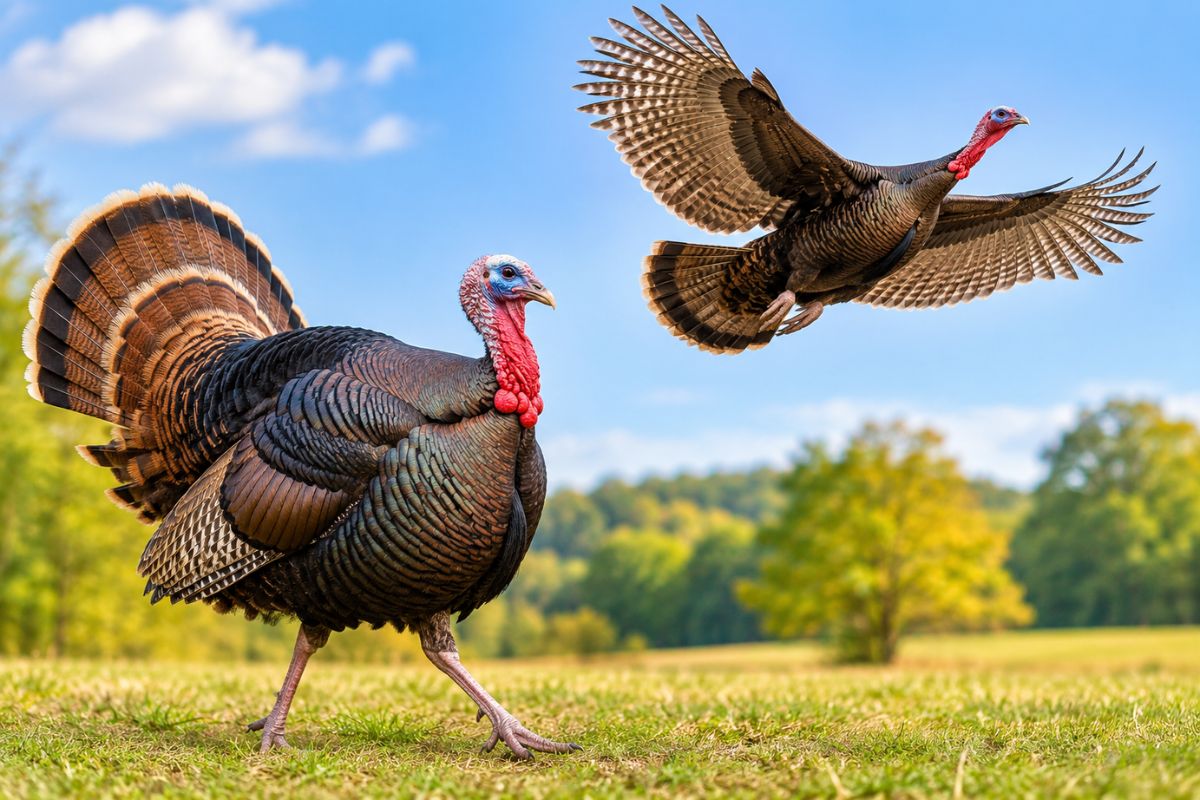
Wild turkeys can fly, and they fly surprisingly fast. They just do it in short bursts. So do turkeys fly like other birds or spend most of their time walking? The honest answer is both — brief, powerful flights and long days on foot.
- They fly in short bursts, not long migrations.
- Top flight speed is roughly 55 mph, about 88 km/h.
- On the ground they run at around 25 mph.
- Most of the day goes on walking and foraging.
- Every evening they fly up into trees to sleep.
- Farmed turkeys are far too heavy to leave the ground.
Do Turkeys Fly Like Other Birds? Not in the Same Way
A goose flies to get somewhere. A wild turkey flies to get out of trouble.
Wild turkeys do not migrate. Audubon’s species guide describes them as non-migratory birds that may simply wander a little in autumn. They never built the stamina for distance. Their wings are broad, rounded, fingered and short, the classic shape of a bird that needs instant lift rather than hours of cruising.
Those wings work like a catapult. They shove a heavy body upward in seconds, then run out of the puff. A turkey can beat a fox away from a hedgerow, but it could never follow a swan across the North Sea.
Parade Pets, published through Yahoo, makes the point neatly: wild turkeys use flight strategically, for short getaways rather than long journeys. Without it, coyotes and bobcats would have a much easier time.
Also Read: Do Elephants Think Humans Are Cute? What the Science Actually Says
Why Turkeys Spend Most of Their Time Walking
Walking is simply cheaper. Flight burns enormous energy, and a 20 lb bird pays a heavy price for every take-off.
Food keeps them grounded too. The Cornell Lab of Ornithology describes them as ground foragers that scratch through leaf litter for acorns, beech nuts, seeds and berries, adding snails, beetles and the odd salamander. None of that is found in the air. So a turkey’s day is a long, patient walk.
The National Wildlife Federation notes they are fast on their feet, with a top running speed of about 25 miles per hour, roughly the pace of a human track star. Running usually solves the problem before flying has to.
Danger splits them neatly. Cornell’s behaviour notes point out that when threatened, females tend to fly while males tend to run. Heavier toms trust their legs. Lighter hens trust their wings.
How Fast and How Far Can Turkeys Fly?
Taylor Finger, a game bird ecologist with the Wisconsin Department of Natural Resources, told Birds & Blooms: “They can run up to 25 miles per hour, and they can fly up to 55 miles per hour.” That is motorway speed for a bird that most of us assume cannot get airborne.
Distance is the limit, not speed. Flights usually cover about a quarter of a mile. Once a turkey has momentum, it sets its wings and glides, and figures gathered by BirdFact put the longest recorded single flight at roughly a mile.
Figures do vary. The US Fish and Wildlife Service gives a lower 18 mph on foot and up to 50 mph in flight, and 1940s studies clocked turkeys nearer 29 to 42 mph. Method explains the gap. Either way: fast, loud, and over in seconds.
They can swim, too. Ohio’s Department of Natural Resources explains the technique — wings tucked, tail spread, legs kicking.
Also Read: Are Humans Mammals? Yes, and the Evidence Is Not Close
Roosting: The One Time Flight Really Matters
At sundown, the walking stops and the climbing begins.
Finger describes, “They roost in trees. At night, that’s where they roost to sleep—they hang out in trees. We have a hard time thinking of them as flying birds, but they fly quite a bit. They get up there to avoid predators.”
Turkeys fly into the lower limbs first, then work upward from branch to branch until they reach a high perch, usually in flocks. The heights are impressive. Rio Grande turkeys studied in the Texas Panhandle and Kansas chose roost trees averaging 45 feet, with the lowest branch about 11 feet up. Hens in Oregon used trees averaging 108 feet.
Audubon notes that poults can make short flights at just one to two weeks old. Getting off the ground is a survival skill, not a trick.
Why Farmed Turkeys Cannot Fly At All
This is the source of the whole myth, and it matters for UK readers especially. The turkey most of us meet is a farmed bird.
Domestic poults can flutter short distances in their first few weeks. Then selective breeding takes over. Decades of breeding for breast meat load the bird with mass exactly where it hurts flight most. The power-to-weight ratio collapses, and the wings can no longer shift the body.
Finger puts wild males at 16 to 25 pounds and females at about 7 to 10 pounds. Audubon’s figures span 5 lb 8 oz to 23 lb 13 oz, with a wingspan of 4 ft 1 in to 4 ft 8 in. Farmed birds routinely pass 25 pounds, and one in the UK was recorded at 86 pounds.
Weight alone is not the whole story. Birds of similar mass, such as the kori bustard, still fly. It is the extreme muscle composition of the modern domestic turkey that grounds it for the long haul.
Farm Sanctuary, which cares for rescued birds, puts the contrast simply: in the wild, although they travel short distances, turkeys can fly at speeds of up to 55 miles per hour and spend nights roosting together high in the treetops.
A Comeback Worth Knowing
As per the NWF Blog, habitat loss and overhunting pushed wild turkeys to the edge by the early twentieth century.
“Turkeys were eradicated from 18 of the 36 states that they had previously been found in,” Finger says. Mass Audubon records the local collapse — the last wild turkey in Massachusetts was shot on Mount Tom in 1851, and just 37 birds were released there between 1972 and 1973. That state now holds more than 30,000.
Nationally, numbers climbed from roughly 200,000 to several million. The National Wild Turkey Federation has long cited around 6 to 7 million, though its recent state-by-state reporting points to nearer 5 million across reporting states, with declines in parts of the south. Treat the higher numbers as a historic peak, not today’s count.
None of this activity happens in Britain. Wild turkeys are North American birds, and the ones here are farmed. So if you have never seen a turkey fly, you have been looking at the wrong turkey.
Also Read: Are There Raccoons in the UK? Separating Facts From Myths
Frequently Asked Questions
Can wild turkeys actually fly?
Ans: Yes. Wild turkeys fly well over short distances and reach around 55 mph. They simply cannot stay airborne for long, so they walk most of the day instead.
Do turkeys spend most of their time walking?
Ans: They do. Turkeys forage on the ground for hours, scratching through leaves for nuts, seeds and insects. Flight is saved for escape and for reaching a roost.
How high can a turkey fly?
Ans: High enough to reach tree branches well above 40 feet, and some roost trees average over 100 feet. They climb limb by limb once they are up.
Why can’t farm turkeys fly?
Ans: They are bred for heavy breast muscles. That extra mass destroys their power-to-weight ratio, so adult farmed turkeys cannot lift themselves off the ground.
Do turkeys sleep in trees?
Ans: Yes, nearly every night. They fly into the lower branches at dusk and move upward to roost in flocks, safely above foxes and other ground predators.
Are turkeys faster running or flying?
Ans: Flying, by a wide margin. They run at about 25 mph but reach roughly 55 mph in the air, though only in short bursts of a few hundred metres.
Sources & References
- NWF Blog – Habitat loss and overhunting pushed wild turkeys to the edge by the early twentieth century.