
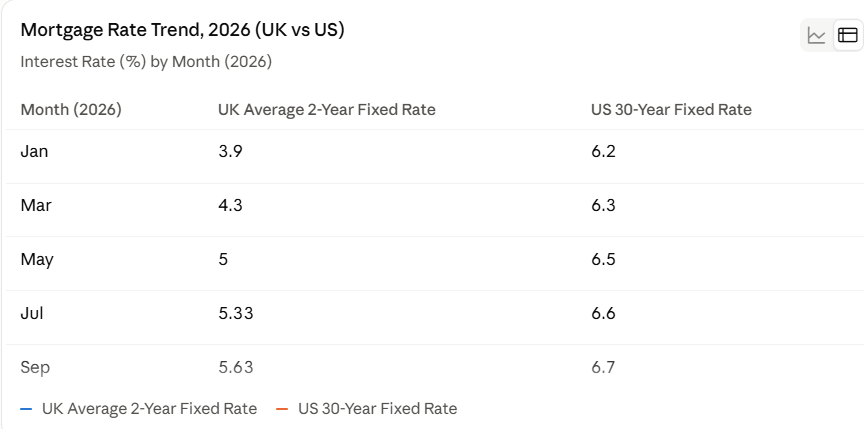
Mortgage quotes look different from what they did in January. Back then, a UK borrower locking in a fixed deal saw rates close to 4%. By September, that same borrower is quoted well over 5.5%. In the US, rates have climbed past 6.7%.
That’s not a small wobble. It changes what people can afford. It changes how many buyers show up at a viewing. And it changes what sellers can realistically ask for.
This article looks at the latest UK and US housing data, central bank decisions, and lender pricing moves. The goal is simple: explain how mortgage rates and home prices are connected right now, and what that means if you’re buying, selling, or just trying to make sense of the headlines.
- UK mortgage rates jumped from near 4% in January to over 5.5% by September, driven by renewed Iran-linked conflict and inflation fears.
- Higher rates shrink buyer borrowing power, cooling demand and weakening sellers’ negotiating leverage.
- Savills flipped its 2026 UK house price forecast from +2% growth to a 2% decline within months.
- US mortgage rates climbed past 6.7%, even as the median home price hit a record $434,100 in July.
- Brokers advise locking in a fixed rate early, since deals are being pulled and repriced within days.
Why Mortgage Rates Jumped in 2026
The short version: geopolitics, energy prices, and inflation collided at a bad moment.
UK mortgage pricing doesn’t move in step with the Bank of England’s base rate. It tracks swap rates instead. Swap rates reflect where markets expect interest rates to head over the next two to five years. Through early 2026, that outlook was calm. Fixed rates even dipped below 4% for the first time since 2022.
Then, from late February, renewed conflict involving Iran pushed oil prices higher. Inflation fears came back. Swap rates climbed fast.
Lenders did what they always do when funding costs rise. They repriced, and they did it quickly. HSBC, Santander, Halifax, NatWest, TSB and others all raised fixed and tracker rates more than once since spring. Some hikes were close to half a percentage point in a single move. Brokers say mortgage deals are now disappearing within days, not weeks. That pace hasn’t been seen since the 2022 mini-budget crisis.
The Bank of England has held its base rate at 3.75% for five meetings in a row, most recently on 30 July. But that hold hides real disagreement. Three of the nine Monetary Policy Committee members voted for a rate rise instead. UK inflation has crept back to 2.9%, well above the 2% target. By early September, the average two-year fixed rate had hit its highest point since mid-August. Markets are watching the next decision on 17 September closely, and nobody is fully confident which way it will go.
The US is seeing something similar. The 30-year fixed mortgage rate climbed to around 6.7% in early September. A 10-year Treasury yield pushing toward 4.8% is part of the reason. Investors are pricing in the chance that the Federal Reserve might raise rates rather than cut them, driven by the same oil-price shock and inflation worries hitting markets on both sides of the Atlantic.
Also Read: How to Start a Business UK With No Money and Make It Happen
How Mortgage Rates Actually Move Home Prices
The mechanics are simple, even if it doesn’t feel that way to a buyer stressed about a viewing.
Most people don’t shop with a sticker price in mind. They shop with a monthly payment in mind. Raise the interest rate on a mortgage, and the same loan costs more each month. To keep payments manageable, buyers need a bigger deposit, a smaller loan, or a cheaper home. Most end up doing the third thing: offering less.
This plays out in three ways.
Borrowing power shrinks. Lenders stress-test affordability against today’s rates. As rates rise, the maximum loan a buyer qualifies for gets smaller, even if their income hasn’t changed at all.
Fewer buyers show up. Some people simply pause their search and wait for rates to settle. That thins out demand at viewings and open houses.
Homes sit longer, and asking prices soften. With fewer buyers competing, sellers lose leverage. A home that would have sold in days can now sit for weeks.
None of this happens overnight. Mortgage pricing reacts to markets within days. House prices, set through actual negotiation between buyers and sellers, usually take months to catch up. That lag is part of why forecasters keep revising their numbers all year instead of getting it right the first time.
What UK Forecasters Are Saying Now
Savills is a good example of how fast the outlook has shifted. At the start of 2026, the firm forecast 2% growth in average UK house prices for the year. By June, after mortgage rates jumped following renewed Middle East tensions, it had flipped that to a 2% fall. That’s a four-point swing, driven almost entirely by the change in borrowing costs.
Lucian Cook, Savills’ head of residential research, said higher borrowing costs and weaker buyer sentiment would weigh on demand for the rest of the year. He also pointed to elevated stock levels, partly from landlords selling up, adding more downward pressure on prices, particularly in London and the South East.
Savills’ longer view is more forgiving. The firm still expects UK house prices to grow around 18.5% over the five years to 2030, down from an earlier forecast of 22.2%, but still positive. That forecast assumes the base rate gradually falls from 3.75% toward 2.5% by 2030, with average mortgage rates easing from roughly 4.8% to 3.5% over the same stretch. In other words, most forecasters see this spike as a detour, not a new normal.
Zoopla tells a slightly calmer story. Its house price index showed annual UK price growth of around 1.3% heading into the second quarter, with a full-year forecast of roughly 1.5%. Zoopla also reports that the number of homes for sale is at its highest level in eight years. That gives buyers more room to negotiate, even where prices are technically still rising. More choice plus higher borrowing costs is exactly the mix that slows price growth without necessarily reversing it everywhere.
The regional picture underneath these averages varies a lot. Zoopla’s data points to stronger prospects in more affordable markets across the North of England and Scotland, where price-to-income ratios leave room to grow. London postcodes, where affordability is already stretched, look softer by comparison.
Also Read: Can You Make £5,000 a Month Dropshipping in the UK? 2026 Facts Check
What’s Happening in the United States
American buyers are facing a similar squeeze, though not an identical one. The median price of an existing home hit a record $434,100 in July, even as mortgage rates climbed back above 6.7%. On a typical financed purchase, that combination pushes the monthly payment on a median-priced home toward roughly a quarter of the average family’s income. That’s part of why many first-time buyers have sat out most of 2025 and 2026.
The US market has an extra layer: inventory. Several major metro areas have already posted year-over-year price declines, even as the national median keeps climbing. That’s partly because national figures get skewed by a mix shift toward higher-priced markets, while individual regions are cooling under affordability pressure. Case-Shiller data has shown some of the weakest annual national price growth since 2011, a sign that a rising headline number can still hide a market losing steam underneath.
What This Means for Buyers, Sellers, and Remortgagers
If you’re buying: get a realistic affordability check before you start house-hunting, not after. The number you can borrow may be smaller than it was six months ago. On the plus side, negotiating power has shifted back toward buyers in many local markets, especially where stock is high.
If you’re selling: price realistically from day one. Overpricing in a market where buyer borrowing power has shrunk usually means a longer wait and a bigger eventual price cut than if you’d priced it right the first time.
If you’re remortgaging: act early. Brokers keep flagging that fixed-rate deals get pulled and repriced within days as lenders react to swap rate moves. Lock in a rate before your current deal ends, and you avoid rolling onto a lender’s standard variable rate, which in the UK now sits well above 7%. That’s a steep premium over fixed products.
Also Read: Did the UK Actually Start a 4-Day Work Week? Here’s the Ground Reality
Frequently Asked Questions
Do house prices always fall when mortgage rates rise?
No, not always, and not right away. Rising rates cut into what buyers can afford to borrow, which puts downward pressure on prices over time. But low housing supply, strong wage growth, or high local demand can offset that effect for a while.
Why did UK mortgage rates rise so sharply in 2026?
The main trigger was renewed conflict involving Iran, which pushed oil prices up and brought inflation fears back. That pushed swap rates higher, which lenders use to price fixed mortgages. HSBC, Santander, Halifax and other major lenders responded by raising rates several times through spring and summer.
Is now a good time to lock in a fixed mortgage rate?
There’s no single right answer here — it depends on your situation and how much risk you’re comfortable with. Most forecasters agree rates are unlikely to fall much before the end of 2026. That’s why many brokers advise people nearing the end of a fixed deal to lock in early rather than risk another increase.
How much have UK house price forecasts changed in 2026?
Savills cut its 2026 forecast from +2% growth to a 2% decline within a few months, pointing to higher mortgage costs. Its five-year forecast to 2030 dropped from 22.2% to 18.5% growth, though it still expects prices to recover as rates ease later in the decade.
Are US and UK housing markets facing the same pressures?
Largely, yes. Both saw mortgage rates rise through 2026 on the back of inflation tied to global energy prices, and both have seen buyer demand strained by affordability. The US shows more regional divergence — some metro areas are already seeing price declines even as the national median hits new highs.
The Bottom Line
Mortgage rates and home prices move together, but not instantly and not evenly. This year has shown how fast an outside shock — in this case, a geopolitical conflict and its knock-on effect on energy prices and inflation — can ripple through to what a lender charges and, eventually, what a seller can ask for. With the Bank of England’s next decision days away and the Federal Reserve facing its own balancing act, both markets are in a holding pattern. Forecasters still expect growth over the medium term. But the next few months will likely stay bumpy for anyone borrowing, buying, or selling.
Sources & References
- Savills: UK House Price Forecast Revised as Higher Mortgage Costs Weigh on Demand
- Propelr: How Rising Mortgage Rates Affect Your House Sale
- i News: HSBC, Halifax, Santander Upping Mortgage Rates as Experts Warn It Could Get Worse
- The Telegraph: Major Banks Increase Mortgage Rates Ahead of BoE Decision
- City AM: Mortgage Rates at Five-Month High Ahead of Bank of England Decision
This article draws on housing market data and commentary from Savills, Zoopla, Propelr, i News, The Telegraph, City AM, The Independent, and current UK and US mortgage pricing data as of September 2026. Mortgage rates and forecasts change often — always confirm current pricing with a lender or independent mortgage broker before making a decision.