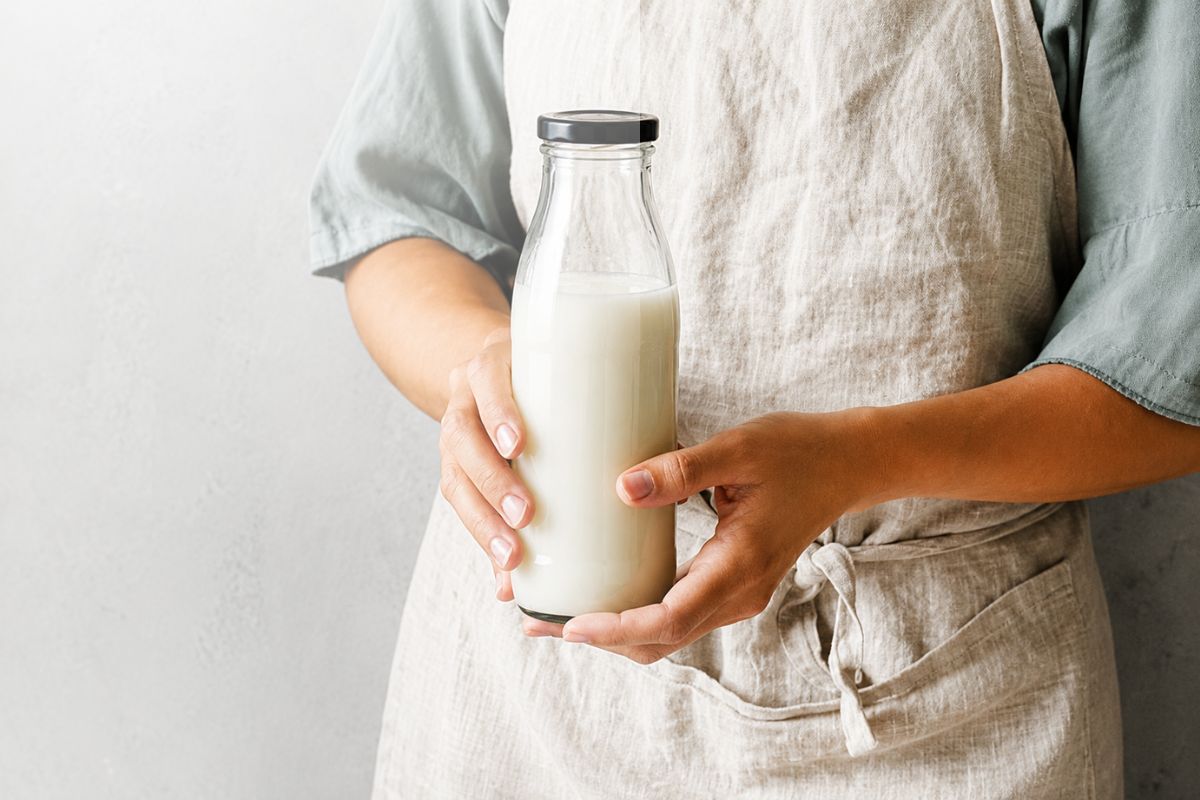
Unhomogenised milk isn’t nutritionally better than the regular carton in your fridge. Same protein, same calcium, same vitamins. What changes is purely physical — whether the cream stays blended through or sits on top exactly where nature left it.
You’ve probably seen it by now: that thick, golden layer sitting proudly on top of a milk bottle at a farm shop, or increasingly, on supermarket shelves too. It’s not a fault. It’s not bad packaging. It’s just cream doing what cream does when nobody’s forced it to mix in. Somewhere along the way, unhomogenised milk turned from a niche farm-shop item into a proper talking point among UK shoppers, most of whom assume it must be the “healthier” option simply because it looks less processed. Is it, though? Or is this more about nostalgia than nutrition?
- Unhomogenised milk contains the same protein, calcium and vitamins as homogenised milk.
- Cream rises to the top by itself instead of mixing uniformly throughout the milk.
- Choose pasteurised unhomogenised milk for the same level of food safety as standard supermarket milk.
- Don’t forget to shake the bottle before you pour the milk since cream naturally rises to the top.
- It has a richer, creamier taste, although it may have a slightly shorter shelf life depending on processing and storage.
At a Glance: Unhomogenised vs Homogenised Milk
| Feature | Unhomogenised Milk | Homogenised Milk |
| Cream | Rises and sits on top | Mixed evenly throughout |
| Nutrition | Same protein, calcium, vitamins | Same protein, calcium, vitamins |
| Safety | Safe if pasteurised | Safe if pasteurised |
| Shelf Life | Slightly shorter | Slightly longer |
| Taste | Richer, more traditional | Smooth, consistent |
| Best For | Coffee, baking, cheese-making | Everyday drinking, cooking |
| Fat Distribution | Cream separates | Evenly dispersed |
| Processing | Skips homogenisation | Homogenised under pressure |
| Appearance | Cream layer visible | Uniform |
| Frothing | Less consistent | Better for coffee |
| Price | Often higher | Usually cheaper |
Also Read: Nutritional Value of Semi Skimmed Milk: Why It’s a Popular UK Choice
Things Worth Knowing Before You Switch
- The nutrition doesn’t change. Whether the fat globules get broken up or left alone makes zero difference to the protein, calcium or vitamin content of milk — it’s a mechanical step, not a nutritional one.
- It’s just as safe, as long as it’s pasteurised. People sometimes lump unhomogenised in with raw milk. They’re not the same thing at all, and the safety standards for pasteurised, unhomogenised milk are identical to what you’d find in any homogenised carton.
- You’ll need to give the bottle a shake. Since the cream separates and floats, your first pour will taste noticeably richer than your last unless you mix it back through first.
- The taste really is different. Plenty of people describe it as richer, or more “old-fashioned” — partly the extra fat near the top, partly just one less processing step between the cow and your cup.
- It’s handy in the kitchen too. Some home bakers like being able to scoop off pure cream for a recipe, then shake the rest through for a decent full-fat milk. One bottle, two options.
- It won’t keep as long. Unhomogenised milk tends to have a shorter shelf life than the homogenised kind, since dispersing the fat evenly is part of what helps ordinary milk stay fresh for longer.
- It behaves differently when heated or whisked. Homogenised milk generally froths and thickens more easily, which is one reason it’s often the go-to for coffee shop drinks, puddings and sauces — unhomogenised milk can act a little less predictably in these situations.
There may still be some controversy over the digestion process, despite some saying that it has already been finalized. In actuality, most of the research comparing unhomogenized milk to homogenized milk has been conducted in laboratory rather than in real-life conditions. Nevertheless, no credible studies have shown that the use of homogenized milk increases the risk of heart disease, diabetes, or allergies.
What Unhomogenised Milk Actually Is
If left under normal circumstances, milk will naturally begin to separate over time, with butter and other fats collecting on top, and the remainder of the liquid gradually becoming diluted. Simply put, unhomogenized milk is milk that has not undergone a process known as homogenization that employs the use of a high pressure device that breaks down milk fats so that they are kept in a suspension state so they can not stratify. That’s why the milk purchased in a supermarket store will look no different from day-to-day or a week after its filling date.
Worth clearing up here: homogenisation and pasteurisation get confused constantly, but they’re doing completely different jobs. Pasteurisation is the heat treatment that kills off harmful bacteria — that’s the safety step. Homogenisation is purely about texture and appearance and has nothing to do with safety whatsoever. So the unhomogenised milk sitting in your local shop has, in almost every case, still been pasteurised. It isn’t raw milk, and it carries no extra risk.
Also Read: Can Stress Cause Hair Loss Overnight? Here’s What the Science Actually Says
So Is It Actually Healthier?
Short answer: not really, and this is where the trend gets ahead of the science. Several reviews have examined whether homogenisation affects digestion or disease risk. While homogenisation changes the size of milk fat globules, current evidence has not found that it reduces nutritional value or increases the risk of heart disease, allergies or diabetes. Most studies showing differences have been laboratory-based rather than clinical trials in humans.

What unhomogenised milk genuinely offers is fewer processing steps, and for a lot of people, that’s reason enough. It feels closer to “real” food, even if the nutrition label reads identically to the carton next to it. Smaller, independent dairies across Britain lean into exactly this — the farm-to-bottle story rather than any actual measurable health claim.
Which is fine. This was probably always a taste and texture decision wearing a health halo. Some people will keep reaching for the smooth, consistent pour of homogenised milk. Others want that cream sitting on top so they can spoon it straight into their coffee. Both are perfectly reasonable choices.
Buying, Storing and Using Unhomogenised Milk
If this is your first time grabbing a bottle of unhomogenised milk, there are a few tips to remember that make a big difference: Store unhomogenised milk properly in the fridge, as close to the back of the fridge as possible rather than the door where the temperature fluctuates more. Because it’s undergone less processing, unhomogenised milk is slightly more susceptible to temperature variations.
Don’t assume the cream on top is a sign of anything beyond normal separation. It’s not a fault, and it’s not a clue about whether the milk is organic, raw or grass-fed — those are separate label details entirely, so it’s worth reading the rest of the packaging rather than judging by the cream layer alone. Always double-check that the bottle says “pasteurised” if food safety matters to you, since unhomogenised on its own only tells you about texture, not treatment.
When it comes to using it, unhomogenised milk is fairly forgiving. Shake it well for an everyday cup of tea or bowl of cereal, or hold back and skim the cream for something richer — a sauce, a homemade custard, or a topping for coffee. Some people even find it works nicely in home baking or cheese-making, since the fat behaves a little differently when it hasn’t been broken down mechanically. None of this requires any special skill; it just takes a bit more attention than pouring from a standard carton.
Why is Unhomogenised Milk Trending Right Now?
It’s not just one thing driving this — a few forces have come together at once, pushing unhomogenised milk from a farm-shop novelty into something shoppers actively seek out.
- Social media appeal: Short videos of that thick cream cap being poured or spooned off tend to do well online, simply because it looks satisfying and different from the standard carton.
- TLess processed food trend: A trend towards less processed foods — everything from sourdough bread to raw honey and unhomogenized milk — has made minimal processing a virtue in itself.
- Small dairy companies have come up with stories: Smaller scale UK dairy companies have used cream-top bottles to stand out in a crowded aisle and develop a farm-to-bottle identity that mass-market brands cannot easily imitate.
- Buying unhomogenized milk means supporting local farmers: For many consumers, buying unhomogenized milk represents support for local, traditional farming techniques over industrial production, even though the nutritional difference is nonexistent.
- Nostalgia: Older shoppers remember glass-bottle deliveries with cream sitting at the neck, while younger shoppers are drawn to the same look simply because it feels more “natural” than a uniform carton — even if, as covered above, the actual health case is thinner than the trend suggests.
Also Read: Do Cold Showers Actually Boost Your Immune System?
Conclusion
Unhomogenised milk isn’t a nutritional upgrade — anyone claiming otherwise is stretching what the evidence actually shows. What it does offer is a more traditional product: less processed, noticeably richer, closer to how milk behaves before industrial equipment gets its hands on it. If you like the taste, the texture, or just the idea of fewer steps between farm and fridge, go for it. Just don’t expect extra goodness that isn’t actually there.
Frequently Asked Questions
Can unhomogenised milk be drunk in a safe way?
It is possible to do this, provided that it has been pasteurized, hence most unhomogenised milk available on the market is safe.
Can unhomogenised milk be used in tea, coffee or cooking?
It can be done, however, one must shake it thoroughly prior to drinking it or get rid of cream, in case of using unhomogenised milk in cooking.
Is unhomogenised milk more expensive than regular milk?
Yes, it is sometimes more costly, especially in the case of small from small independent producers rather than large industrial plants.
Is unhomogenised milk the same as raw milk?
Not really, as unhomogenised milk means that the cream has separated on its own, whereas raw milk indicates whether it has been pasteurized or not.
How long does unhomogenised milk stay good after opened?
It has the same shelf life as pasteurized milk, however, it usually expires earlier when it is out of refrigerator and meets required storage conditions.
Sources & References
Non homogenized milk cream benefits