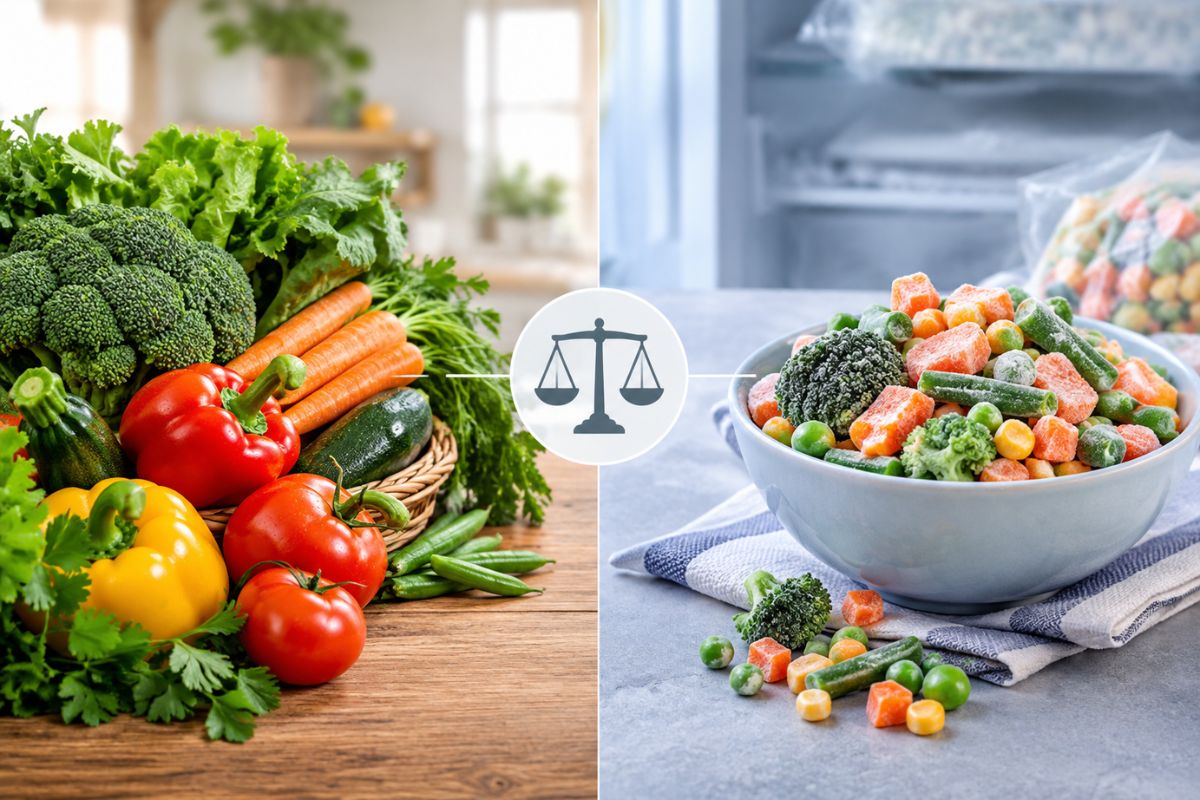
Quick Answer: No. Frozen veg is picked ripe and frozen within hours, so most of its vitamins, minerals and fibre are preserved. “Fresh” veg starts losing nutrients the second it’s picked. Leave it in the fridge for a few days and the frozen bag often wins.
- Freezer veg is picked ripe and frozen within hours.
- Blanching consumes some vitamin C and B vitamins.
- Fibre, minerals and vitamin A are barely affected.
- After a few days in the fridge, fresh often falls behind.
Is Frozen Veg Less Nutritious Than Fresh? What the Research Shows
Studies test things differently, so the results may vary. But the big picture’s the same. Healthline’s look at the studies found freezing preserves nutrients, fresh and frozen come out nutritionally equal. When frozen, the drop is very minimal.
Grace Esler, a registered oncology dietitian, told Everyday Health: “There is no significant difference in nutrient density between fresh and frozen vegetables.” In one study, she flagged that some frozen veg had more vitamin C and vitamin E, plus extra riboflavin in broccoli and peas. Beta-carotene dropped a bit. None of the gaps were significant.
How Fresh Veg Reaches Your Kitchen
Most fresh veg is picked before it’s properly ripe, so it can finish ripening on the road. That means less time to build up vitamins, minerals, and antioxidants.
In the US, produce can spend three days to several weeks in transit. Some apples and pears sit in controlled storage for up to 12 months. Then it’s one to three days on the shop shelf and up to a week in your fridge.
Meanwhile, the vitamin C declines gradually. It starts dropping the moment veg is harvested. Green peas can lose up to 51% of their vitamin C in the first 24 to 48 hours. Heat, light and oxygen make it worse.
Also Read: Is Intermittent Fasting Safe? 5 Myths the 2026 Research Clears Up
How Frozen Veg is Made
Frozen veg is picked at peak ripeness, when it’s most nutritious. Then it’s washed, blanched, chopped, frozen and bagged, often within a few hours. Usually nothing else goes in.
Fruit tends to dodge the blanching bit because it ruins the texture. Instead, it might get a dash of ascorbic acid (a form of vitamin C) or some sugar.
Gene Lester, a plant physiologist at the US Department of Agriculture, told CNN that veg picked at its peak can pack 10% to 50% more nutrients than veg picked early for the fresh aisle. On fresh veg, he’s blunt: “After it’s four or five or seven days old, it’s a completely different equation.”
Culinary scientist Ali Bouzari reckons freezing beats every other way of preserving nutrients. Speed matters too, says GoodRx. Fast freezing makes tiny ice crystals. Slow freezing makes big, stabby ones that pierce the veg and kill a few nutrients.
Where Frozen Veg Loses Out: Blanching
Before freezing, most veg gets a dunk in boiling water. This kills bacteria and stops the enzymes that turn your peas grey and tasteless.
It’s also where the biggest nutrient loss happens. Water-soluble vitamins like C and the B gang leak out. Losses range from 10% to 80%, averaging about 50%. In one study, antioxidant activity dropped by 30% in peas and a hefty 50% in spinach. After that, though, levels held firm at −20°C. The upside is that vitamins A, E, carotenoids, minerals and fibre are unaffected.
When Frozen Beats Fresh
One study found fresh produce slipped below frozen levels after just three days in the fridge. Another study found that frozen produce was the healthier choice after five days.
Victoria Taylor, senior dietitian at the British Heart Foundation, puts it simply. Fruit and veg lose nutrients from the moment they’re picked, and freezing soon after harvest helps keep them in. It’s often cheaper too, lasts up to 12 months and cuts waste.
When Fresh Still Wins
Veg from your garden, eaten within a day or so, is still king. And nobody wants a frozen salad.
Watery veg is a nightmare in the freezer. Cucumber, lettuce, tomatoes and spring onions all come out limp and soggy. Peas, carrots, sweetcorn, green beans and asparagus freeze much better than watery veg.
Dietitian Chloe McLeod adds that the fresh aisle has more choice, which keeps dinners interesting. Her advice is to stock both. It’s worth remembering that the National Diet and Nutrition Survey (2019 to 2023) found only 17% of UK adults met their 5 A Day target. Frozen counts, by the way.
How to Pick and Cook Frozen Veg
- Choose plain bags. No added salt, sugar or gloopy sauce.
- Give the bag a feel. You want loose, rock-hard pieces, not one frozen brick.
- Ice crystals or torn packaging? Put it back. It’s probably thawed and refrozen.
- Shove bags to the back of the freezer and use them within a year.
- Cook straight from frozen, and don’t overdo it.
- EatingWell recommends steaming or microwaving over boiling.
- Finish with a squeeze of lemon to top up lost vitamin C.
Final Verdict
So, is frozen veg less nutritious than fresh? So, it’s not worth losing sleep over. Frozen veg is picked ripe and frozen fast, so most of the nutrition stays in. Blanching destroys some vitamin C and B vitamins, but fibre, minerals and carotenoids remain intact. Fresh veg, meanwhile, leaks nutrients every day it spends on lorries, shelves and in your fridge. Buy fresh in season when you’ll eat it soon, and keep plain frozen bags for manic weeks.
Also Read: Myth or Fact: Does Eating Carrots Improve Eyesight?
Frequently Asked Questions
Is frozen veg as healthy as fresh?
Ans: Yes. Frozen veg is nutritionally close to fresh and can beat veg that’s been lurking in your fridge for days.
Do vegetables lose nutrients when frozen?
Ans: Yes, but only a small amount is lost, mainly during blanching. Vitamin C and B vitamins are affected, but fibre and minerals aren’t.
Does frozen veg count towards my 5 A Day?
Ans: It does. An 80 g portion counts as one, just like fresh.
How long can I keep frozen veg?
Ans: Aim to use it within 12 months. Nutrients slowly fade the longer it sits.
Is frozen veg better than tinned?
Ans: Usually. Tinned veg gets more heat processing, which can cost a few nutrients.
Can you eat frozen veg without cooking it?
Ans: Best not. Frozen veg can carry bacteria, so always cook it first.
Sources & References
- CNN – Veg picked at its peak can pack 10% to 50% more nutrients than veg picked early for the fresh aisle.