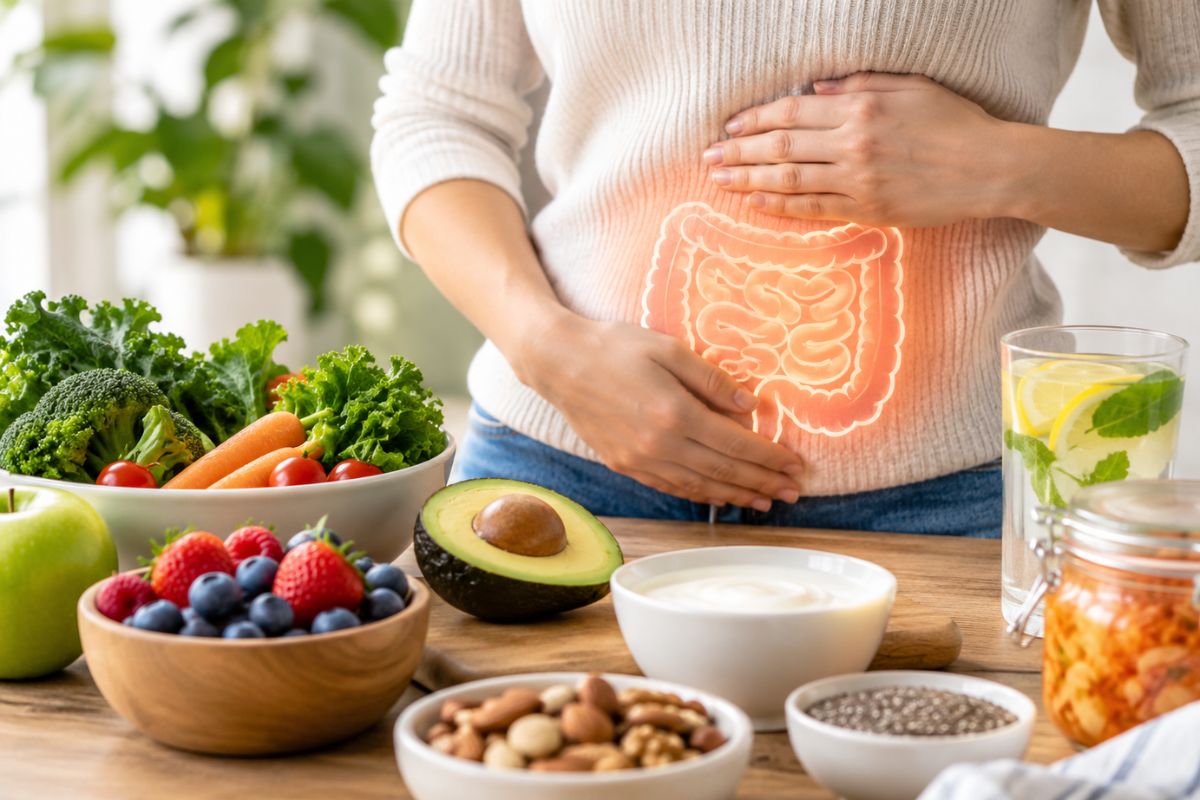
So, can diet improve gut health? For most healthy adults, yes. The change with the best evidence behind it is boring: eat more fibre-rich plant foods, eat fewer ultra-processed ones, and stick with it for months. Detoxes and “reset” plans don’t hold up. Neither does the idea of one perfect gut diet. Probiotics fall somewhere in between, since they clearly help in a few situations and remain unproven in many others.
- Fibre has the most consistent support of any dietary factor.
- A big 2026 Nature Medicine analysis found food processing was the strongest dietary predictor of microbial diversity. Other 2026 data push back on how large that effect is.
- “30 plants a week” is a catchy target, not a proven threshold.
- Your gut doesn’t need cleansing. Constipation is the only practical reason to “clean out” the bowel.
- Whether a probiotic works depends on the strain and the condition.
- Cutting out whole food groups can cause problems of its own.
What People Actually Mean by “Gut Health”
Doctors use “gut” for the whole digestive tract. In wellness talk, it usually means the large intestine, where the British Nutrition Foundation (BNF) says more than 100 trillion microbes live. Roughly 3,000 bacterial species may turn up in the human gut overall, yet any one person carries only 100 to 150 at a time. That’s why nobody can point to a single “ideal” microbiome. The BNF says diversity and balance seem to matter most.
It also explains the hype. The science is real, but it’s messy and personal. Gastroenterologist John Goff of National Jewish Health (March 2026) made the point simply: two healthy people can have very different microbiomes, so what suits you may not suit someone else.
Also Read: Is Coffee Beneficial for Health? The Facts Explained
What Holds Up: Fibre and Plants
When fibre reaches the colon, microbes ferment it and release compounds like short-chain fatty acids. According to the BNF, these can help keep the gut lining healthy and calm inflammation. Michigan State University’s Robert Quinn, speaking in January 2025 after about ten years studying the microbiome, boils his advice down to one line: eat fibre, lots of it.
Trials point the same way, though the effects are modest. A 2025 randomised, double-blind trial in Microorganisms gave 105 healthy adults either low-fibre foods (2.2 g/day of total fibre) or high-fibre foods (8.2 g/day) for four weeks. The high-fibre group had more bacteria associated with short-chain fatty acid production, Bifidobacterium among them, and reported better bowel-related quality of life. Effects on sleep and skin were limited, per the authors. Keep the scale in mind: the groups differed by only about 6 g of fibre a day, over four weeks. It shows a direction of travel, not a cure.
The BNF adds that Mediterranean-style eating and wholegrain-rich diets are linked to more beneficial bacterial activity, while the typical low-fibre Western diet is linked to lower diversity.
Where The Evidence Disagrees: Ultra-Processed Food
Does ultra-processed food damage the microbiome? Probably, but how much is still argued over.
The strongest case comes from the Nature Medicine study, which used data from over 10,000 adults in Israel’s Human Phenotype Project. Diet was associated with more than 92% of the 724 bacterial species analysed. Food processing was the single strongest dietary predictor of diversity, and minimally processed diets, whether plant-based or not, tracked with higher diversity. Those links held over four years of follow-up. There are caveats. Participants were mostly healthy adults aged 40 to 70, they reported their own diets, and the study’s food-swap simulation hasn’t been tested in a real-world trial.
Pulling the other way, a 2026 poster abstract from the Harvard-linked Microbiome Among Nurses study (2,288 participants) found no association between ultra-processed food intake and overall microbial diversity. It explained only about 0.4% of the differences in microbiome composition between people, although it did relate to wider changes in the fecal metabolome.
The BNF sits in the middle. Studies connect high ultra-processed food intake with poorer gut health, it says, but there isn’t enough evidence to claim these foods directly disrupt gut bacteria. These diets also tend to be low in fibre, which muddies the comparison.
Either way, the advice doesn’t change. Basing meals on whole, minimally processed food is low-risk, and several lines of evidence support it.
Myth: You Need 30 Plants a Week
The number comes from a study in which people who ate 30 or more plant types weekly had more diverse gut bacteria than people who ate 10 or fewer. The BNF notes that the study was a snapshot, so it can’t prove 30 is a magic cutoff. Variety is still a good idea. The BNF’s evidence-based floor is five portions of fruit and veg a day, plus wholegrains, beans, lentils, nuts and seeds.
Myth: There’s One Perfect Microbiome, or One Diet for Everybody
Goff is blunt that it isn’t clear one diet fits all. A plan that transforms an influencer’s gut may do nothing for yours, and dramatic changes can cause discomfort in some people. His advice is to try something else if one approach fails, not to decide diet can’t help.
Myth: Your Gut Needs a Detox
“Your gut doesn’t need to be cleansed” is Goff’s position, and he says there’s no data behind many detox practices. He adds that coffee enemas and unsupervised fecal transplants can be dangerous. Noisy Guts, a low-FODMAP food brand, makes a similar argument: your liver and kidneys already deal with toxins.
Also Read: Quick & Simple Bedtime Tricks: How Can You Fall Asleep Fast
The Grey Area: Probiotics and Fermented Foods
Probiotics aren’t useless, and they aren’t magic.
The BNF lists several areas with supporting evidence: preventing antibiotic-associated diarrhoea, lowering the risk of C. difficile infection, protecting against traveller’s diarrhoea, easing constipation, relieving IBS bloating, and helping people with ulcerative colitis stay well longer. It stresses that choosing the right strain matters.
Clinical guidelines are more cautious. The American Gastroenterological Association’s 2020 guideline found too little evidence for most digestive conditions. It did back certain probiotics for preventing C. difficile in people on antibiotics and for pouchitis, and it stressed that effects depend on the specific strain or combination. That guideline covers patients with GI disorders, not generally healthy people.
Why don’t they simply “stick”? Quinn likens it to tipping a freshwater fish into a coral reef. A newcomer struggles to settle into an ecosystem that’s already established. He still thinks probiotics are unlikely to harm healthy people. Goff agrees that permanently reshaping the microbiome is far harder than the ads suggest.
Fermented foods such as yogurt, kefir and kimchi may help too. The BNF warns that their live-microbe content is inconsistent, and some products, like certain jars of sauerkraut or sourdough, may contain none after heat processing. Look for “live or active cultures” on the label, and keep an eye on salt and sugar.
Sweeteners are another open question. The BNF says studies are mixed: some find little effect, others suggest shifts in gut microbes. It’s not enough for firm conclusions.
Myth: The Gut is a “Second Brain”
The gut and brain do talk to each other in both directions, and the gut has its own enteric nervous system. Still, a 2026 article by a dietitian at Symprove (a probiotic company, so read it with that in mind) argues the “second brain” label oversells things. The gut coordinates digestion, but it doesn’t think. The BNF similarly says early studies hint that gut bacteria may affect mood, with more research needed.
Myth: Cutting Out Food Groups Is a Safe Shortcut
Goff warns that dropping too many foods can lower protein intake or lead to vitamin deficiencies, and that strict vegan diets may need B12 supplements. In extreme cases, repeatedly eliminating foods can feed anxiety about eating and develop into avoidant/restrictive food intake disorder (ARFID).
Specific conditions change the picture. Noisy Guts points out that a gluten-free diet is necessary for coeliac disease or non-coeliac gluten sensitivity, but it isn’t a general gut fix. Some people with IBS react to the fructans in wheat, not the gluten. Soluble fibre such as oats suits some people with IBS, so “fibre is bad for IBS” is too blunt. If you suspect a food intolerance, see a doctor or registered dietitian.
A Practical Plan
- Raise your fibre slowly, from beans, lentils, oats, wholegrains, fruit, vegetables, nuts and seeds.
- Add variety, but don’t chase a number.
- Build meals around minimally processed foods, and cook at home when you can.
- Drink enough fluid. The BNF suggests 6 to 8 glasses a day as a rough guide, with needs shifting by body size, climate and activity.
- Keep sleep, meal times and exercise steady, as Goff suggests.
- Avoid unnecessary antibiotics, and finish prescribed ones. Quinn’s phrase: don’t try to outsmart your doctor.
- Be patient. Noisy Guts says regularity can improve within days but full microbiome effects can take weeks, which fits the trial above.
When To See a Doctor
Ongoing changes in bowel habits or other gut symptoms call for a medical check, not another diet experiment. Anyone with a health condition or weakened immunity should talk to a doctor before taking probiotic supplements, per NHS advice quoted by the BNF.
Frequently Asked Questions
Can diet improve gut health?
Yes. Fibre-rich, minimally processed eating has the best support, and benefits build over weeks to months.
What’s the best food for gut health?
No single food wins. A mix of plants supplies different fibres. Quinn singles out prunes for their fibre and the complex sugars that feed colon microbes.
Do probiotics work?
Sometimes, for particular conditions and strains. For most healthy people the benefit is unproven.
Do I need a gut detox?
No. Goff says the gut doesn’t need cleansing.
Do I have to eat 30 plants a week?
No. It’s a popular target, not a proven requirement.
Are ultra-processed foods bad for the gut?
Several studies link them to poorer gut health, but the size of the effect and whether they directly cause it are still being researched.
Sources & References
- British Nutrition Foundation. How your gut affects your health.
- National Jewish Health. Gut Health: Separating Fact From
- Michigan State University (MSUToday). Ask the expert: MSU researcher separates fact from fiction in gut health
- Nature Medicine (2026). Diet and gut microbiome study using Israel’s
- Microorganisms (2025). Effects of Dietary Fiber Supplementation on Gut Microbiota and Bowel Function in Healthy Adults: A Randomized Controlled Trial.